Reviewed · PRIVATE TOURS
Authentic private tour of Barcelona in French
Barcelona rewards slow walking. This 2-hour private tour in French uses a small group (8 people, limited to 10 max) to guide you through El Born, the Gothic Quarter, and key Catalan landmarks, with a guide who shares personal anecdotes and local tips. I especially like the story-driven stops and the way the route mixes famous exteriors with quieter corners you would likely miss on your own. The main drawback to plan for is that it is mostly on foot and some streets can be narrow, so comfortable shoes matter.
If you’re here for a smarter first look at Barcelona, this tour is a solid way to get your bearings fast, and it stays family-friendly (kids up to 12 go free). It is also a great match if you want French commentary, not a rush of audio earbuds. Just note that paid monument entry is not included, so you’ll still need tickets if you want to go inside places that charge admission.
In This Review
- Key things I’d mark on your Barcelona plan
- Arriving at Centro Cultural del Born: the tour starts before it starts
- El Born Centre Cultural and El Born streets: medieval bones, modern pace
- St. Mary of the Sea Cathedral: a landmark with a story behind it
- Moco Museum and Picasso Museum exteriors: art stops without the ticket maze
- Gothic Quarter essentials: where your guide turns buildings into character
- Barcelona Cathedral: quick, but focused on what to look for
- The Kiss of Freedom: a quick stop that breaks up the heavy history
- Palace of Catalan Music: modernism you can spot from the street
- A brief extra segment: the tour includes a short fifth stop
- Sant Pere de les Puelles and the move toward larger avenues
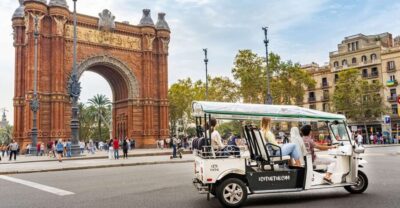
- Arc de Triomf: symbolism plus a breather after lots of alleys
- Parc de la Ciutadella: where the tour lets you reset
- Value for your money: why 34 dollars can make sense here
- What’s not included, and how to plan around it
- Your guide quality: the difference between facts and stories
- Who this tour is best for (and who should skip it)
- Should you book this private French Barcelona tour?
- FAQ
- Is the tour offered in French?
- How long is the Barcelona tour?
- What is the price per person?
- Do kids get a discount?
- What is the meeting point?
- Are entrance tickets to monuments included?
- Is the tour mostly walking, and is it wheelchair accessible?
Key things I’d mark on your Barcelona plan
- French-only guidance with a real local storyteller, not a script
- Small-group feel (8 people, up to 10 max), good for questions
- Born and Gothic Quarter focus on streets, architecture details, and daily-life history
- Picture-friendly modern highlights like the Arc de Triomf and Parc de la Ciutadella areas
- Family value since kids up to 12 go free
- Gaudí and Catalan modernism exteriors, without the ticket headache
Arriving at Centro Cultural del Born: the tour starts before it starts
The meeting point is the main entrance of Centro Cultural del Born, in the Born district. Look for the large brick facade and the interior metal structure, and you will be set. The nice thing here is that you do not just “meet and go.” You also get a short free visit inside the center first, so you get context and momentum right away.
For your planning, this matters because it turns the tour into more than a walk with random stops. You begin with the area’s layers, and then the route makes sense as you move outward into El Born and the Gothic Quarter. If you arrive about 10 minutes early, you’ll avoid the awkward early scramble and be ready to listen.
El Born Centre Cultural and El Born streets: medieval bones, modern pace
Your first guided segments are El Born Centre Cultural (about 15 minutes) and then El Born itself (about 10 minutes). Even if you’ve seen Barcelona photos before, El Born is one of those neighborhoods where the streets do the talking. Expect medieval alleys, architectural texture, and the kind of street-level history that does not show up well in broad landmark photos.
This is also where the tour becomes genuinely useful for independent travel later. A good guide here points out what to notice on your own after the walk. You’ll get anecdotes about how the neighborhood functioned, what changed over time, and what is still visible today. If you’re traveling with kids, this part is usually where attention stays up because the streets are visually interesting and the pace is guided.
Other things to see around Barcelona
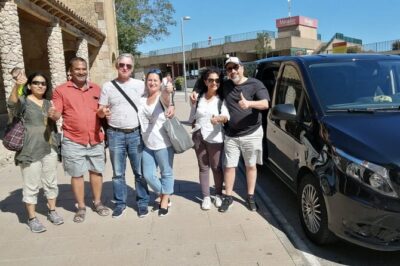
- Montserrat Monastery Small Group or Private Tour Hotel pick-up
★ 5.0 · 5,144 reviews - Tour Welcome Barcelona with Local Guide in Eco Tuk Tuk Private
★ 5.0 · 1,882 reviews - Barcelona Private Tour by Sidecar Motorcycle
★ 5.0 · 1,750 reviews
St. Mary of the Sea Cathedral: a landmark with a story behind it
Next comes St. Mary of the Sea Cathedral, with a short guided stop (about 10 minutes). Catalan and Gothic-era churches can feel like “just another church” if you only skim the exterior. Here, the value is in what the guide frames for you: why this place mattered, how the area developed, and what to look for in the details when you’re standing outside.
One practical note: you won’t be doing a long interior visit in this format. If your goal is a deep dive into the building itself, you will likely want a separate ticketed visit later. But as an orientation stop, it gives your eyes context for the rest of the Gothic Quarter.
Moco Museum and Picasso Museum exteriors: art stops without the ticket maze
You then have two quick art-focused segments: Moco Museum and Picasso Museum, each around 10 minutes. Since paid entrance is not included, this is not a “go in and stay” experience. Instead, it’s about using famous names as reference points, then linking them to the neighborhood and the wider creative identity of the area.
If you like having your museum options organized, this is a smart approach. You get names to remember, and you can decide later whether to buy tickets for the collections that interest you most. It also helps if you want to avoid waiting in lines while still getting a sense of where the art energy is concentrated.
Gothic Quarter essentials: where your guide turns buildings into character
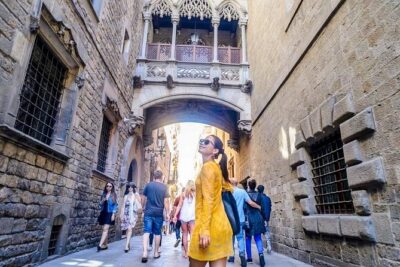
The route then moves into the Gothic Quarter (about 15 minutes). This is one of the most praised parts of the experience because the guide does not just list monuments. The tour uses the street layout and small architectural cues to tell stories that feel like they belong to real people.
This is where you’re likely to hear the kind of anecdotes that make the difference between a photo walk and a “now I understand this place” walk. In French, it also helps that the pace is conversational, so you can ask quick questions if something sparks curiosity.
Watch for narrow streets and tight corners. The tour is wheelchair accessible, but accessibility can still be affected by street widths and turns. If anyone in your group has mobility limits, comfortable shoes and a steady pace will matter.
Barcelona Cathedral: quick, but focused on what to look for
After the Gothic Quarter, you stop at Barcelona Cathedral for about 10 minutes. The time is short, so the goal is not to “see everything.” Instead, the guide helps you spot the most meaningful elements from the outside and connects them to the neighborhood’s history and identity.
This is a good point to use your camera thoughtfully. Rather than taking 30 similar shots, you’ll get better photos if you focus on the specific angles your guide points out. You’ll leave with a clearer idea of what stands out visually and where to frame it if you return.
One ticket rarely covers it all. Here's what else is nearby.
- Barcelona: Sagrada Familia Entry Ticket with Audio Guide★ 4.6 · 105,312 reviews
- Barcelona: Park Güell Admission Ticket★ 4.4 · 76,534 reviews
- Barcelona: Casa Batlló Entry with Self-Audioguide Tour★ 4.7 · 25,359 reviews
- Barcelona: Montjuïc Cable Car Roundtrip Ticket★ 4.5 · 22,368 reviews
- Barcelona: Hola Barcelona Public Transport Travel Card★ 4.5 · 20,985 reviews
- Barcelona: 24 or 48-Hour Hop-On Hop-Off Bus Tour★ 4.4 · 20,872 reviews
The Kiss of Freedom: a quick stop that breaks up the heavy history
Then there is The Kiss of Freedom (about 10 minutes). This stop is refreshing because it adds a modern, human-scale moment amid older architecture. It’s the kind of place where you can pause, stretch your legs, and reset your attention before the route turns to major Catalan modernist landmarks.
Even if you do not linger long, it helps the walk feel varied. Barcelona is not only medieval stone. The city keeps layering new meaning onto old spaces.
Palace of Catalan Music: modernism you can spot from the street
A highlight stop is the Palace of Catalan Music (Palau de la Música Catalana), with about 10 minutes of guided time. You are looking at the exterior and nearby context rather than an interior ticketed visit.
Why this matters: Catalan modernism has a strong look, and recognizing it from the outside makes your later city wandering easier. If you choose to book an interior tour or concert later, you’ll already know what features to look for because your first sighting had an explanation behind it.
Also, this stop helps tie the story of Barcelona to culture and identity, not just architecture. Even with limited time, the guide’s framing gives you a reason to care.
A brief extra segment: the tour includes a short fifth stop
Your itinerary includes another guided segment of about 5 minutes at a stop that is listed without a specific landmark name in the provided details. You’ll still get a guided explanation for that segment as the route continues toward Sant Pere de les Puelles.
Since the exact spot is not specified here, treat it as a “quick context stop.” In practice, these short segments usually help connect neighborhoods or point out a detail that would be easy to miss if you’re only chasing big names.
Sant Pere de les Puelles and the move toward larger avenues
Next is Sant Pere de les Puelles (about 5 minutes). This is a smaller, more focused stop, and that’s part of its value. The tour keeps shifting from big landmark energy to quieter, more local texture. You get a sense of how Barcelona mixes famous monuments with lesser-known corners that still feel meaningful.
From there, the walk transitions toward wider, more open space as you move in the direction of major sights like Arc de Triomf.
Arc de Triomf: symbolism plus a breather after lots of alleys
You spend about 15 minutes at Arc de Triomf. Compared with the tight Gothic Quarter streets, this is a change in scale, and your legs will appreciate it. It is also a great photo area because the arch gives you strong structure and a natural sense of direction.
A useful way to enjoy this part is to slow down and look around the surrounding avenue. A good guide helps you understand what the arch represents, so it doesn’t become just a pretty frame for photos.
Parc de la Ciutadella: where the tour lets you reset
The final major stop is Parc de la Ciutadella (about 15 minutes). This functions like a decompression zone after a run of stone streets and architectural viewing. You get a bit of green space and open air, even if the time is short.
This is especially helpful if you’re traveling with kids, or if you’re a first-time visitor who might otherwise feel overloaded. After the park, you loop back to the Centro Cultural del Born to finish the tour.
Value for your money: why 34 dollars can make sense here
At $34 per person for 2 hours, you’re paying for a few things that are hard to DIY effectively in a foreign language.
First, you’re buying time and context. A guided walk like this helps you connect neighborhoods, understand why certain buildings are famous, and notice details that you might not catch from street level alone. Second, you get a small-group format, which means questions and direction can actually happen. Third, French language guidance is a clear advantage if you want to stay in the language rather than switch to English or struggle through translation apps.
For families, the value jumps. Since kids up to 12 go free, you can bring younger travelers without the cost exploding. That is often the difference between a “nice idea” and something you actually book.
What’s not included, and how to plan around it
This tour is designed to be an exterior and street-level experience. Paid monument entrance tickets are not included, so if you want interiors like Sagrada Família or Casa Batlló, you’ll need separate tickets.
Transportation is also not included. That means you should plan to reach the meeting point on your own. The good news is the route makes sense as a walk, and the guide’s stop selection keeps you from wasting time moving randomly across the city.
Finally, food and drinks are not included. If you need a snack break, pick a short one before you start, or plan to eat after you return to the Born area.
Your guide quality: the difference between facts and stories
One of the standout themes here is the guide’s personality. In French, Patrick comes through as friendly and engaging, with a strong sense of history and a knack for sharing anecdotes and practical good plans. That mix matters because it helps your brain turn the sightseeing into something you can remember.
The tour also adapts. If you want a slightly different pace or you’re traveling with kids, the experience can shift to match your group. That flexibility is a big deal in a city like Barcelona, where crowds and street quirks can throw off a fixed schedule.
Who this tour is best for (and who should skip it)
This tour is ideal if you:
- want a French guided walk instead of audio
- like neighborhoods and street-level details, not only ticketed monuments
- are planning a first trip and want a route that helps you explore on your own later
- travel with kids, since younger travelers up to 12 go free
You might choose something else if you:
- only care about interior museum time and long visits
- hate walking and need long, seated breaks
- want a ticket-inclusive plan with guaranteed entry to specific paid monuments
Should you book this private French Barcelona tour?
Yes, I would book it if you want your first taste of Barcelona to feel personal and guided, not generic. The small-group size, French-only storytelling, and the way the route connects the Born, Gothic Quarter, and major sights make it strong value for the price.
If your calendar allows, use this tour as your orientation day. Then, go back later under your own steam for the entrances that interest you most. Barcelona is a city you’ll enjoy more after you learn how the streets and buildings connect, and this tour gives you that link fast.
FAQ
Is the tour offered in French?
Yes. The live tour guide speaks French throughout the experience.
How long is the Barcelona tour?
The duration is 2 hours.
What is the price per person?
The price is listed as $34 per person.
Do kids get a discount?
Yes. Kids up to 12 years old go free.
What is the meeting point?
You meet in front of the main entrance of Centro Cultural del Born, in the Born district. It has a large brick facade and an interior metal structure.
Are entrance tickets to monuments included?
No. Entrance tickets to paid monuments are not included.
Is the tour mostly walking, and is it wheelchair accessible?
The tour is mostly on foot, and it is listed as wheelchair accessible. Some streets can be narrow, so comfortable shoes help for everyone.
The latest to open for booking

Private Tours, side by side.
Montserrat Monastery Small Group or Private Tour Hotel pick-up
Read our review →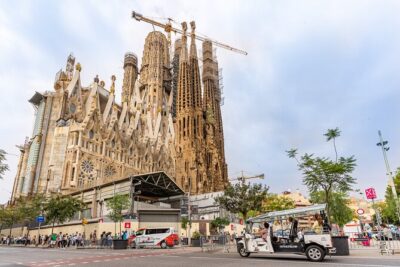
Tour Welcome Barcelona with Local Guide in Eco Tuk Tuk Private
Read our review →
Barcelona Private Tour by Sidecar Motorcycle
Read our review →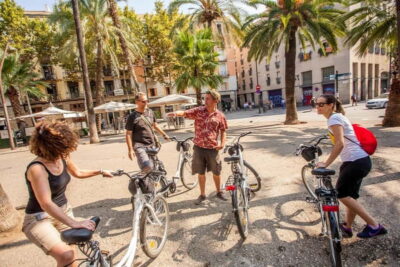
Barcelona Helicopter, Sailboat & Old Town Private Walking Tour
Read our review →
Helicopter, Boat Ride & Old Town Private Tour
Read our review →