
Reviewed · WALKING TOURS
Barcelona Audioguided walking tour 2h30 and 26 reviews
Barcelona on foot, without the rush
This 2 hours 30 minutes audioguided walk is a smart way to connect famous landmarks with the street details you’d otherwise miss, thanks to 26 audio stops and a 3D map. I like that it works with a mobile ticket and offline playback, so you are not stuck hunting for service or extra paperwork. One thing to consider: you will still be walking a lot, and any paid entrances along the route are not included, so plan your stops accordingly.
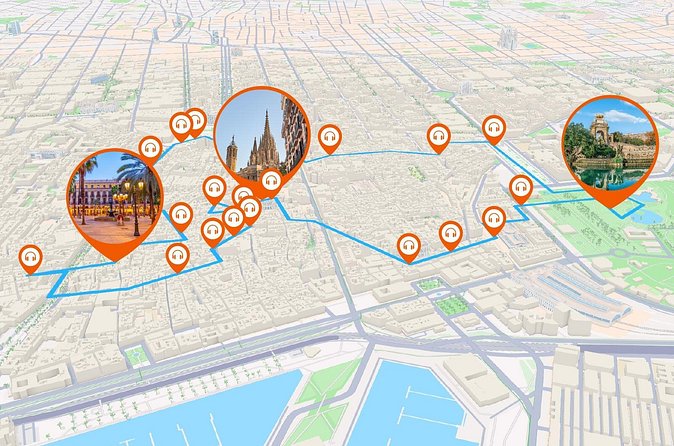
You start at Plaça de Catalunya and then thread your way through El Born, Parc de la Ciutadella, the Ramblas and Boqueria area, and the Gothic Quarter down to cathedral territory and King’s Square. The audio comes with text transcripts and photo tips, which is handy when you want to pause, read, and take your time.
In This Review
- Key highlights worth your attention
- How the audio tour actually works in Barcelona
- Starting at Plaça de Catalunya, the route finds its rhythm
- El Born’s Gothic set pieces: Santa Maria del Mar and Passig del Born
- From the Born’s culture center to Parc de la Ciutadella
- World-Fair park buildings and the red-brick details
- Plaça Catalunya to La Rambla and La Boqueria, with smarter pacing
- Miró’s big mosaic and Plaça del Pi’s Gothic calm
- Roman wall leftovers and New Baths on del Banys nous
- Plaça Reial, Palais Güell, and that Gaudí you can actually plan for
- Gothic Quarter calm: Sant Felip Neri, Casa de l’Ardiaca, and cathedral art
- Roman crossroads, a marble bridge, and King’s Square for the long view
- Price, pace, and who this walking audio tour is best for
- Should you book this Barcelona audio walking tour?
- FAQ
- How long is the Barcelona audioguided walking tour?
- How much does the tour cost?
- What language is available?
- Do I need an internet connection during the walk?
- Are entrance tickets included for stops along the route?
- Are headphones provided?
- Where do I start and how does the tour end?
Key highlights worth your attention
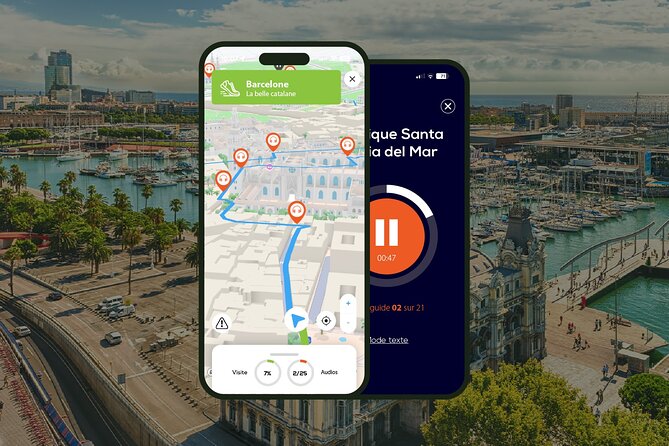
- 26 audio comments plus full text transcripts, so you can listen or read as you walk
- Offline mode to save your phone data while you move through dense central streets
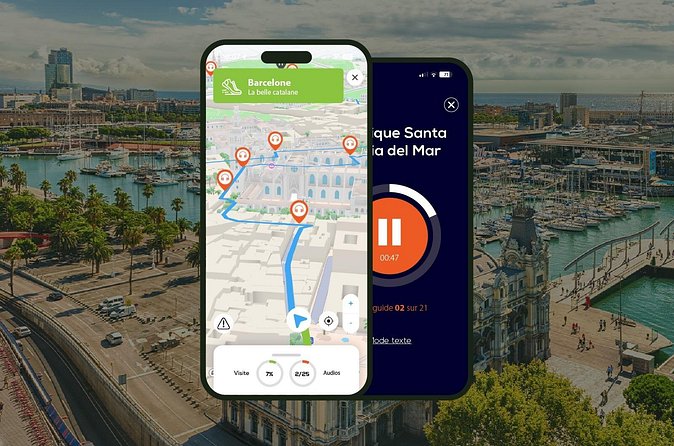
- Interactive navigation with a 3D map, useful when lanes, alleys, and squares start to blur
- A route that mixes big names with “wait, what is that?” details like Passig del Born and Casa de l’Ardiaca
- Stops tied to real places with specific context, like Santa Maria del Mar and the Castellers tribute artwork
- A great setup for solo time, since you control your pace and can repeat sections if you want
How the audio tour actually works in Barcelona
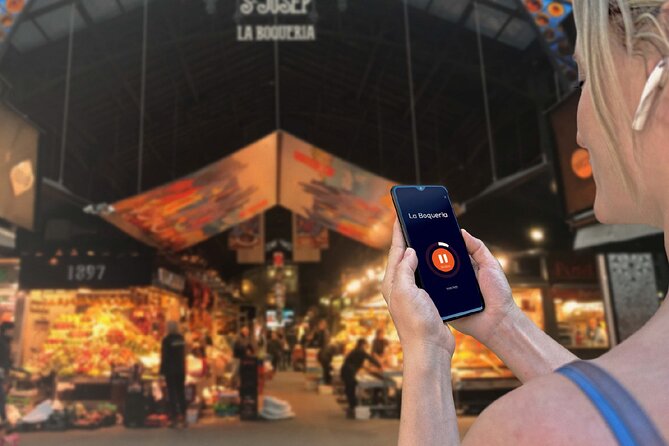
This is a self-guided walking experience, but it is not the usual “press play and hope” setup. You get immediate access to the audio circuit with a mobile ticket, and there is no deadline pressure or expiration window during your visit window.
The audio is offered in English (and also French and Spanish), with text transcripts for every audio comment. That matters more than it sounds. If the street is noisy, you can glance at the text instead of fighting to catch every word.
You also get interactive navigation with a 3D map. In central Barcelona, that helps when you want to confirm you are turning into the right side street, especially around the El Born lanes and later in the Gothic Quarter.
And then there is the practical bonus: offline mode, so you are not paying for roaming just to hear a tour. If you like to keep your phone charged and your costs low, this is a big plus.
Starting at Plaça de Catalunya, the route finds its rhythm
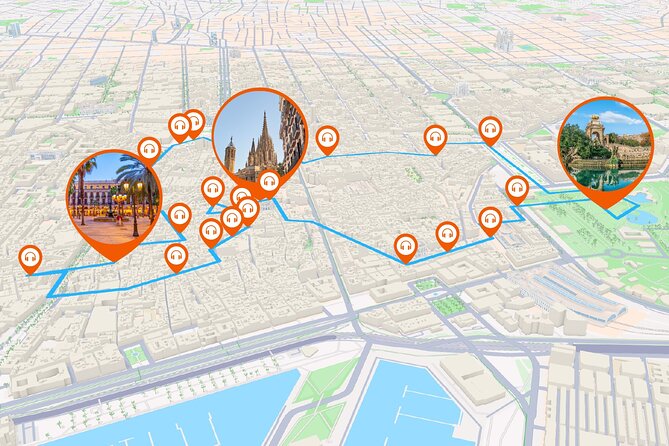
Your walking loop starts and ends back at Plaça de Catalunya, right where a lot of Barcelona movement funnels together. That is helpful because it makes the tour feel doable as part of a longer day. You can arrive, start walking, and still have an easy anchor for breaks and navigation.
From there, the route quickly teaches you how the city connects. You are not just seeing isolated sights. You are following a thread from medieval Barcelona through 18th-century influence, into the parks built for major events, then right into the market and cathedral neighborhood vibe.
Expect a steady rhythm: major landmarks, then short transitions through alleys, squares, and streets that explain how the city grew. The audio even flags moments where you should look for specific architectural features, so you know what to aim for when you turn a corner.
If you want a tour that helps you get your bearings fast, this does it without forcing you into a rigid group schedule.
Other things to see around Barcelona
- Barcelona Tapas and Wine Experience Small-Group Walking Tour
★ 5.0 · 5,804 reviews - Barcelona: Tapas Walking Tour with Food, Wine, and History
★ 4.8 · 4,261 reviews - Barcelona: Food Walking Tour with Tapas and Wine
★ 4.9 · 2,180 reviews
El Born’s Gothic set pieces: Santa Maria del Mar and Passig del Born
One of the earliest “pay attention” moments is Basilica of Santa Maria del Mar. The audio frames it as a top example of Gothic architecture, with special focus on harmony and proportion. That is exactly the kind of cue that makes a building feel more understandable rather than just impressive from the outside.
A short walk later, you pass into the world of Passig del Born, a wider, harmonious alley with medieval roots. Here the audio connects the street shape to what used to happen there, including tournaments and knighthoods. The result is that you start seeing the street as a historical stage, not just a corridor between attractions.
This section works especially well if you like “architecture plus story.” You get enough context that when you look up, you know what you are seeing, and when you walk forward, you know why the lane feels the way it does.
From the Born’s culture center to Parc de la Ciutadella
The tour brings you to the Born area’s culture and memory center, described as housed in a former point of sale sometimes called an Iron and Glass Cathedral. Even if you do not enter any extra spaces, the audio framing helps you appreciate the building as a transformation of old commercial life into modern cultural presentation.
Then you shift into urban park mode with Barcelona’s Citadel Park, the kind of city green you can compare to other big-world parks without pretending it is the same. The point is the pause it gives you. After dense streets, the open space lets your brain reset.
In the park, the highlight is the waterfall fountain inspired by the Trevi fountain. You are not just walking past it. The audio suggests you get the context back in your head, so you look at it with the right reference.
You also reach the Triumph Arch, built as part of the monumental gateway for a World’s Fair setting in the Citadel area. It is the sort of stop where the architecture reads differently once you know it was tied to an event and designed to funnel people into something big.
World-Fair park buildings and the red-brick details
After the arch, the route steers you toward a striking red brick building described with pillars, mosaic-covered facades, and exuberant decoration. This is one of those Barcelona “how did they build that here?” moments, and the audio helps you see it as part of the park’s bigger design language.
You are also led toward Els Quatre Gats, introduced with its medieval-castle vibe and its role as a famous cabaret that opened in 1897. Even if you never go inside, the audio explanation gives the exterior a cultural job description. It is no longer just a cool storefront look.
This segment is a great example of how the tour balances big photo opportunities with softer “understand what it meant” moments. The park lets you slow down, and the architecture keeps your attention.
Plaça Catalunya to La Rambla and La Boqueria, with smarter pacing
Back into city streets, the route hits Plaça Catalunya again as a central junction. From there, it goes to the Rambla, framed as crowded but also built over the bed of a dry river. That single fact can change how you interpret the street. It is still busy, but it feels like a real piece of geography now, not just a famous name.
On the way, you pass the Palace of Virreina, described as built in 1778 at the request of Manuel Amat, the former Viceroy of Peru. That timing detail matters because it roots the palace in specific Spanish colonial administration, not vague “old palace” storytelling.
The tour also draws you toward the Palace of Virreina’s entrance and then into the Boqueria market world through a colored glass metal entrance. La Boqueria is described as one of the largest covered markets in Europe and a Barcelona institution. Even if you treat it as a browsing stop instead of a full meal plan, it is a place where the audio context makes your visit feel less random.
If you want value, think of Boqueria as a sampling and observation opportunity, not necessarily an all-in gastronomic commitment. The audio helps you focus on why the market matters in daily life.
One ticket rarely covers it all. Here's what else is nearby.
- Barcelona: Sagrada Familia Entry Ticket with Audio Guide★ 4.6 · 105,312 reviews
- Barcelona: Park Güell Admission Ticket★ 4.4 · 76,534 reviews
- Barcelona: Casa Batlló Entry with Self-Audioguide Tour★ 4.7 · 25,359 reviews
- Barcelona: Montjuïc Cable Car Roundtrip Ticket★ 4.5 · 22,368 reviews
- Barcelona: Hola Barcelona Public Transport Travel Card★ 4.5 · 20,985 reviews
- Barcelona: 24 or 48-Hour Hop-On Hop-Off Bus Tour★ 4.4 · 20,872 reviews
Miró’s big mosaic and Plaça del Pi’s Gothic calm
If you cannot fit the Miró Museum into your itinerary, the tour gives you a different way to meet Miró: a huge mosaic tied to the famous painter’s style. It is positioned so you do not need extra tickets to get that visual hit.
Then you head to Plaça del Pi, in front of the Basilica of the same name. The current building dates to 1319 and is presented as Gothic with a unique rose window. This is another case where the audio cues your attention, so you do not just see a church facade, you see the design element it is famous for.
Plaça del Pi also works as a tonal change after Rambla energy. The pace feels more controllable, and the space gives you a moment to breathe before you move into the narrower lanes and wall-adjacent streets that define the Gothic Quarter.
Roman wall leftovers and New Baths on del Banys nous
One of my favorite kinds of tour moments is when you realize the city is layered. Here, you walk along del Banys nous, a street that ran alongside the Roman wall. The name translates as New Baths, tied to ancient public baths founded in 1160 where water was abundant.
Even though you may not see “a Roman wall museum” at every step, the audio’s explanation turns the street name and placement into a clue. You start to read the urban geography like it is a timeline.
This section also highlights how the tour keeps moving you between eras without stopping you for long detours. It is a good match for visitors who want to understand Barcelona quickly, but still want the walk to feel like you are going somewhere.
Plaça Reial, Palais Güell, and that Gaudí you can actually plan for
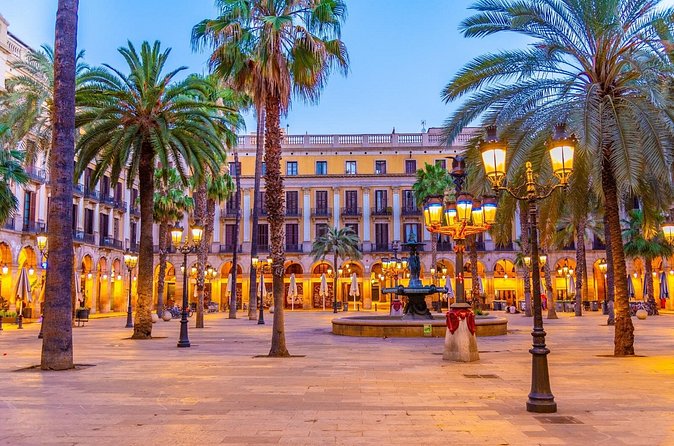
The tour stops at Plaça Royale, described as classy with perfect proportions, porticoes, palm trees, and a fountain. The audio even explains a name story, saying it was thought to be called Royal because of beauty, though it also suggests it should be associated with Spanish heroes’ square after the independence struggle against the Napoleonic Empire. Either way, it gives you a reason to look up and notice the geometry.
Then comes Palais Güell, directly attributed to Gaudí. The big practical note is that it is said to be the only one that can be visited from top to bottom. That matters because if you want an actual interior visit, this gives you a sensible target. If you do not have time or you choose not to pay, the exterior still earns its place because you know it is a complete interior experience.
This part of the route is ideal if you are doing Barcelona on limited days. You get context for the buildings even when you are not entering every ticketed stop.
Gothic Quarter calm: Sant Felip Neri, Casa de l’Ardiaca, and cathedral art
As the route moves deeper toward the cathedral area, it introduces a small square, Sant Felip Neri, described as secret and quiet amid the city’s pressure. The audio explains it is presided over by a rare baroque building from the 18th century, linked as a dependency of the convent of the Congregation of the Oratory.
Then you get near the cathedral and encounter Casa de l’Ardiaca, literally the house of the archdeacon. The audio notes the ecclesiastical class has since disappeared, which helps you understand why a building like this still exists even if its original role does not.
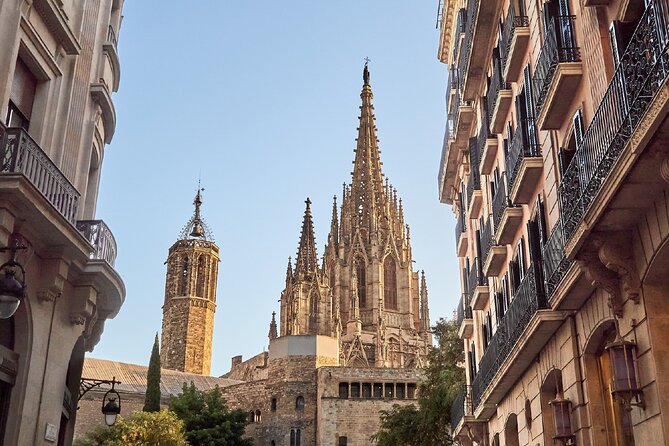
Next you are told about Sainte Eulàlia, presented as Barcelona’s patron saint. The audio states the dedication is to both the patron saint of the Diocese of Barcelona and the Holy Cross. When you reach the cathedral, that context can make your viewing feel more meaningful than just photo hunting.
The tour also explicitly calls out the gargoyles, described as full of sculptures with mysteries and messages. Even if you do not “solve” every detail, this is a strong prompt to slow down and look for the small carvings that turn the facade into a storybook.
Roman crossroads, a marble bridge, and King’s Square for the long view
Before the cathedral area fully takes over your attention, the route points out a moment tied to Barcelona’s ancient name, Barcino. You reach crossroads of two main Roman roads where the Roman forum and the temple of Augustus were located. That is one of those “you are standing where history used to run” reminders that can make a walking tour feel bigger than the route length.
You then pass a superb marble suspension bridge on Rue Bisbe. It is framed as a classic Gothic Quarter image, but the tour notes it was added in the 20th century. That contrast is a useful lesson: cities often preserve a look while changing elements later. The audio encourages you to enjoy the blend.
The tour also references a tribute to the Castellers, described as a wire-like abstract artwork. It is easy to overlook public art if you do not know what it is meant to honor. Here, the audio gives you a reason to stop, look, and interpret it instead of just passing through.
Finally, it takes you to King’s Square, described as a medieval time-travel area associated with counts of Barcelona. Facing the royal palace, it served as a barnyard for the castle and hosted markets and tournaments. The focus on what the space used to do helps you understand why the square feels built for crowd energy, even when it is quiet in front of you.
Price, pace, and who this walking audio tour is best for
At about $7.14 per group (up to 15), the value here is strong, especially for a 2 hours 30 minutes route packed with major sights plus supporting context. Since it is per group, it can be a bargain if you are traveling with friends, but it is also perfectly fine for solo travel because the tour design is self-paced.
The route is best for:
- First-timers who want an organized way to hit classic areas fast
- People who like to walk and read small details, not just take selfies at landmarks
- Solo travelers who do not want to coordinate a group schedule
- Visitors who want audio context in English, with transcripts for clarity
What to consider before you go:
- You are covering a lot of central ground, so wear comfortable shoes and plan for real walking time.
- Entrance fees to paid sites along the way are not included, so decide in advance which interior visits you want to pay for.
- Headphones are not included, but headphones are optional. You might prefer your own wired or Bluetooth pair so the audio stays clear.
Should you book this Barcelona audio walking tour?
I’d say book it if you want a guided-feeling route without a guide collecting a group from shop to shop. It is good at explaining what you are looking at, and it does it in a way that keeps you moving, from Santa Maria del Mar through the Gothic Quarter and cathedral area, with parks and markets in between.
I would skip or rethink if you only want a short “top 5 sights” experience. This tour is more like a half-day city course, and you get the best value when you commit to the full walk.
One last practical tip: start with your phone charged and storage free, so you can use offline mode comfortably. If you do that, you will get a full day’s worth of Barcelona context in a single, well-structured loop.
FAQ
How long is the Barcelona audioguided walking tour?
It runs for about 2 hours 30 minutes.
How much does the tour cost?
The price is $7.14 per group (up to 15).
What language is available?
The tour is offered in English, with additional languages also available (French and Spanish).
Do I need an internet connection during the walk?
No. Offline mode is included, so you can listen without data consumption during the visit.
Are entrance tickets included for stops along the route?
No. Entrance fees to paid establishments along the route are not included.
Are headphones provided?
Headphones are not included. Using headphones is optional.
Where do I start and how does the tour end?
You start at Plaça de Catalunya, Eixample, 08002 Barcelona, Spain, and the activity ends back at the meeting point.
The latest to open for booking


Walking Tours, side by side.
Barcelona Tapas and Wine Experience Small-Group Walking Tour
Read our review →
Tapas Walking Tour with Food, Wine, and History
Read our review →

Barcelona Tapas Walking Tour: Food, Wine & History
Read our review →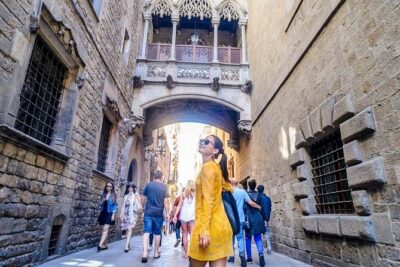
Barcelona Helicopter, Sailboat & Old Town Private Walking Tour
Read our review →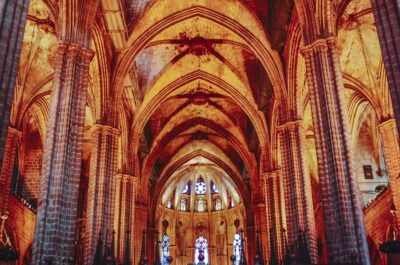
Guided Food Walking Tour with Tapas and Wine
Read our review →Where else this one turns up