
Reviewed · HISTORICAL TOURS
Barcelona Graffiti & Art Stories
Street art is the easiest way to read a city fast. In Barcelona, this walk helps you spot murals, stencils, paste-ups, and the smaller “blink and you miss it” details that most people ignore, especially around MACBA and the surrounding streets. I really liked the way the tour connects what you see to the people behind it, and how guides like Tornike bring the walls to life with real stories and sharp context. One thing to consider: it is a walking tour focused on street art, not big monuments, so you’ll get more out of it if you enjoy looking closely and taking photos.
You’ll move through El Raval, the Gothic Quarter, and El Born, with stops that shift from street corners packed with color to calmer gallery spaces along Carrer d’Avinyó. Expect an urban-style route, including the areas around Joaquín Costa, plus guided visits that make graffiti culture feel less like a rumor and more like an art scene with its own rules and momentum.
Timing is tight in the best way, lasting about 2 to 2.5 hours, starting at Olivia Plaza Hotel and finishing after you’ve had time to look, listen, and shoot pictures. At $28 per person, it can feel like a small price for a guided art story plus gallery admission, but you should still plan on wearing comfortable shoes and carrying water so the pace feels good instead of tiring.
In This Review
- Key Points That Make This Tour Worth Your Time
- Where Street Art Really Lives in Barcelona
- Meeting Point at Plaça de Catalunya, Then Off to the Walls
- MACBA and Joaquín Costa: The Shortcut to Understanding the Scene
- Rambla del Raval and Nou de la Rambla: How to Look Longer
- Carrer d’Avinyó: Where Street Art Culture Meets Galleries
- What You Learn From the Guide, Not Just the Art
- Price and Time: Is $28 Good Value?
- Practical Tips So the Walk Feels Easy
- Who This Tour Suits Best
- Should You Book This Barcelona Graffiti Walk?
- FAQ
- How long is the Barcelona Graffiti & Art Stories tour?
- Where is the meeting point?
- What language is the tour offered in?
- What does the price include?
- Do I need transportation to join the tour?
- What should I bring?
- Is the tour wheelchair accessible and can it be private or small-group?
Key Points That Make This Tour Worth Your Time
- Raval to El Born on foot: You’ll cover multiple neighborhoods where street art changes by the block.
- MACBA and Joaquín Costa as your anchor points: Two areas that turn looking into an actual art lesson.
- Photo-friendly guidance: Tornike-style hosting includes helping you capture what you see.
- Carrer d’Avinyó gallery stops: Street art culture meets contemporary exhibition spaces.
- Small-group energy: Private or small groups keep the pace flexible and questions welcome.
- Real artistic formats: You’ll notice murals, graffiti, stencils, paste-ups, and stickers.
Where Street Art Really Lives in Barcelona
Barcelona street art has a particular flavor because the city treats walls like public conversation. One corner can feel playful, another can feel political, and a third can be purely experimental. That is exactly why this tour works. You are not just walking through pretty scenery, you are learning how to “read” what the city is saying.
The route centers on three neighborhoods most visitors treat as background between attractions: El Raval, the Gothic Quarter, and El Born. Each has its own rhythm. Raval is the loud visual newspaper. The Gothic Quarter shifts tone with tighter street geometry and more contrast between old stone and newer spray-painted statements. El Born adds a more artsy, design-minded feel that pairs well with the final gallery stops.
I also like that the tour is honest about the fact that street art is in motion. Even with a fixed route, what you see can vary because the city constantly updates its surfaces. That makes the experience feel current, not museum-static.
Meeting Point at Plaça de Catalunya, Then Off to the Walls
Your guide waits outside Olivia Plaza Hotel on Plaça de Catalunya (Pl. de Catalunya, 19, Ciutat Vella, 08002 Barcelona), easy to spot by a green umbrella. You’ll meet in a central, practical spot, then head toward the creative hotspots around MACBA and the Joaquín Costa area.
This matters more than it sounds. If you start in the center and then get walked out to the places where graffiti actually clusters, you spend less time asking locals for directions and more time focusing on what you came for. A guide also helps you stay oriented when the streets turn narrow and twisty, especially in older quarters.
The tour runs in English, and it is designed for walking, with wheelchair accessibility noted by the provider. If mobility is a concern, it’s smart to confirm how the route handles tighter segments, but you at least have accessibility information on the booking side.
Other things to see around Barcelona
- Barcelona: Tapas Walking Tour with Food, Wine, and History
★ 4.8 · 4,261 reviews - Highlights & Hidden Spots of Barcelona Bike Tour w/ Local Guide
★ 4.5 · 3,009 reviews - Barcelona Tapas Walking Tour: Food, Wine & History
★ 4.5 · 1,928 reviews
MACBA and Joaquín Costa: The Shortcut to Understanding the Scene
The early portion of the tour sets you up for everything that follows. You begin in the area around MACBA, then spend time in the nearby streets around Joaquín Costa, where graffiti culture gathers and spreads.
Here is why this start is valuable: it gives you a baseline. Once you understand what kinds of styles and messages you’re likely to encounter in this zone, the rest of the walk becomes easier. You stop seeing random marks on walls and start noticing patterns, techniques, and how artists choose locations.
You’ll likely see more than one “type” of street art within a short span. That can include graffiti, murals, and smaller-format work like stencils or stickers. The guide’s job is to connect the details to meaning, so you can tell the difference between something that is just colorful and something that is intentionally placed.
Rambla del Raval and Nou de la Rambla: How to Look Longer
When you move along Rambla del Raval and Nou de la Rambla, the tour starts doing its best trick. It teaches you how to slow down without losing momentum.
Street art here tends to layer quickly. You might notice a larger mural, then a stencil nearby, then a paste-up layered over older paint. The city can look messy if you rush. With a guide, it turns into a timeline of who’s speaking now and who spoke before.
You’ll hear about street art as urban storytelling. That phrase sounds broad, but in practice it means you start paying attention to what artists are trying to say: creativity versus control, local voice versus outsider attention, playful images versus more serious statements. Even when you do not agree with every message, you learn how the visuals are working.
A practical tip that helps on these stretches: take a step back before you take photos. Many of the best details sit just a little off the “main” subject, like a hidden tag, a short slogan, or a secondary figure that only makes sense once you’re seeing the whole composition.
Carrer d’Avinyó: Where Street Art Culture Meets Galleries
After the street segments, the tour shifts gears to Carrer d’Avinyó and visits Base Elements and Arte Vista. This is one of the tour’s smartest moves, because it bridges two worlds people often separate: graffiti culture outside, and contemporary art spaces inside.
You’ll get a guided look that connects the outdoor art language to how artists express themselves when they have different materials, different audiences, and different rules for display. You do not have to be a specialist to enjoy this part. It’s basically a translation service, from walls to exhibitions.
Why I think this matters: street art can feel like it’s “just there,” but galleries help you see how artists build themes across formats. You’ll likely notice how ideas travel from sticker-sized commentary to larger visual concepts that can live in a curated setting.
Also, since the tour includes admission to the galleries, you avoid the common problem of paying separately for the indoor stops. That keeps your total experience smoother and easier to budget.
What You Learn From the Guide, Not Just the Art
The heart of the tour is the guide. In the reviews I saw, one name came up again and again: Tornike. The praise wasn’t generic. People mentioned his enthusiasm, his amount of information, and the fact that he kept time for details instead of racing to “get through the route.”
That style matters on a street art walk, because the best stuff is often not obvious from ten feet away. You need someone who can point out what to look for, how to interpret it, and why that particular wall matters. This tour is built around that idea: insider stories and artist insights that help you see more than surface-level color.
There’s also a fun practical angle. One review mentioned the guide acting like an art photographer. Translation: you can get help getting better angles and capturing the right details without ruining the flow of the tour.
One ticket rarely covers it all. Here's what else is nearby.
- Barcelona: Sagrada Familia Entry Ticket with Audio Guide★ 4.6 · 105,312 reviews
- Barcelona: Park Güell Admission Ticket★ 4.4 · 76,534 reviews
- Barcelona: Casa Batlló Entry with Self-Audioguide Tour★ 4.7 · 25,359 reviews
- Barcelona: Montjuïc Cable Car Roundtrip Ticket★ 4.5 · 22,368 reviews
- Barcelona: Hola Barcelona Public Transport Travel Card★ 4.5 · 20,985 reviews
- Barcelona: 24 or 48-Hour Hop-On Hop-Off Bus Tour★ 4.4 · 20,872 reviews
Price and Time: Is $28 Good Value?
At $28 per person for 2 to 2.5 hours, the value depends on what you want from Barcelona. If your priority is history and landmark sightseeing, this might feel too art-focused and too walking-heavy. If your priority is creative culture and you enjoy looking closely, it is a pretty efficient deal.
Here’s what you get for that price:
- A live English tour guide
- Time in multiple neighborhoods tied to street art culture
- Street art and graffiti viewing
- Gallery admission, which is often where costs creep up on short tours
You also save a bit of hassle because the tour is designed around walking and includes the key stops. Transport to the meeting point is not included, but once you’re with the guide, the experience stays structured.
If you’re budgeting, think of it as a guided “art immersion” session for a morning or afternoon slot. The gallery admission and the guided interpretation help justify the cost more than you might expect from a simple stroll.
Practical Tips So the Walk Feels Easy
This is a walking tour, so you’ll enjoy it more when you prep like a pro. The essentials are straightforward: comfortable shoes, camera, sunscreen, and water. Even if the weather looks mild, street art looking often means standing, crouching, and shooting photos at angles that make you forget you’re outdoors.
I also suggest you charge your phone fully or bring a spare battery if you’re serious about photos. Street art is photogenic, but it also makes you want to capture context, like the street corner, not just the artwork. That can eat storage fast.
One more small strategy: pick one or two art details per stop that you want to understand. Let the guide’s explanations help you form a personal mini-collection of what you learned. That way, the tour feels focused rather than like a visual flood.
Who This Tour Suits Best
This is ideal if you like:
- Street art in real streets, not only in photos
- Learning the stories behind murals and graffiti
- Contemporary art in Barcelona that connects to the street scene
- Taking your time with details, stencils, stickers, and paste-ups
It may not be the best choice if you want only must-see landmarks with minimal walking. You’ll also get more value if you feel comfortable in older neighborhoods with narrow streets. The upside is you experience Barcelona as locals do, not as a sanitized postcard route.
If you’re traveling with someone who is less interested in graffiti, the gallery segment helps. It gives a second doorway into the same ideas, using a more familiar art-world setting.
Should You Book This Barcelona Graffiti Walk?
If you want Barcelona that feels current, human, and slightly rebellious in a creative way, I’d book it. The biggest reason is the structure: it combines neighborhood street art time with gallery visits and wraps it all into explanations from a guide known for energy and useful detail, like Tornike.
If you’re on a short schedule, this is also one of the easier ways to see several distinct areas without hopping between multiple paid attractions. And with the included gallery admission, it’s easier to feel that your money went into the experience, not just transportation logistics.
Just go in with the right mindset: wear good shoes, bring water, and expect to look longer than you usually would at city walls. If you do that, you’ll finish the tour seeing Barcelona differently, like every corner has a voice.
FAQ
How long is the Barcelona Graffiti & Art Stories tour?
The tour lasts about 2 to 2.5 hours.
Where is the meeting point?
Meet your guide in front of Olivia Plaza Hotel at Pl. de Catalunya, 19, Ciutat Vella, 08002 Barcelona. The guide will be waiting with a green umbrella.
What language is the tour offered in?
The tour is offered in English.
What does the price include?
The price includes a live tour guide, admission to the galleries, and street art and graffiti viewing.
Do I need transportation to join the tour?
Transportation to the meeting point is not included, so you’ll need to get there on your own.
What should I bring?
Bring comfortable shoes, a camera, sunscreen, and water.
Is the tour wheelchair accessible and can it be private or small-group?
The tour is listed as wheelchair accessible, and private or small groups are available.
The latest to open for booking

Historical Tours, side by side.

Tapas Walking Tour with Food, Wine, and History
Read our review →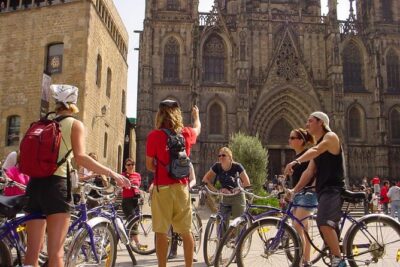
Highlights & Hidden Spots of Barcelona Bike Tour w/ Local Guide
Read our review →
Barcelona Tapas Walking Tour: Food, Wine & History
Read our review →
Barcelona 3-hour Bike or E-Bike Tour: Highlights and Hidden Gems
Read our review →

Barcelona Old Town Tapas Tour: Vermouth, Bites & Hidden Gems
Read our review →
Barcelona Erotic Museum – Explore Art, History & Fun
Read our review →Where else this one turns up