Reviewed · TICKETS & ENTRY PASSES
Barcelona: Palau Baró de Quadras Tickets and Guided Tour
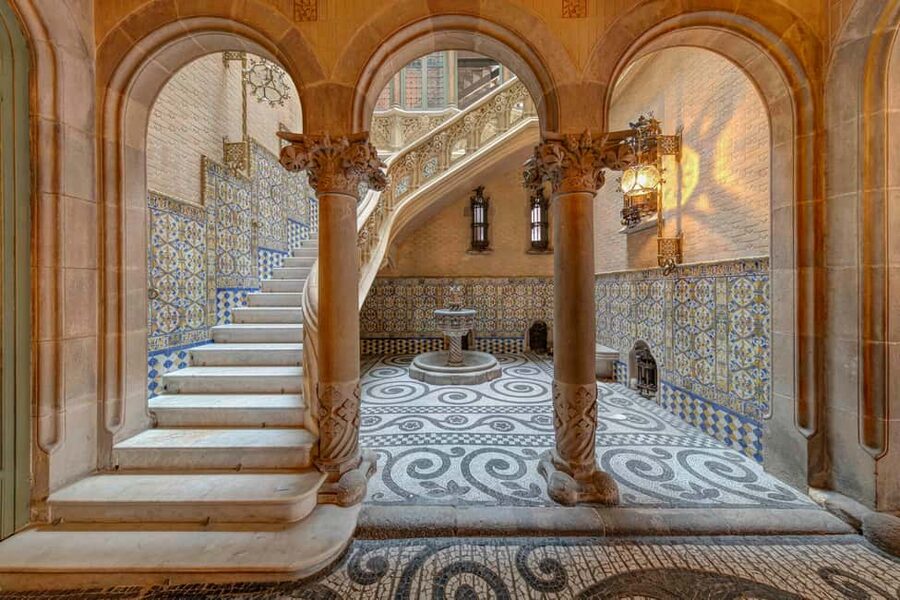
Walking into a Modernist palace feels like time travel. The Palau del Baró de Quadras was renovated by Josep Puig i Cadafalch from 1902 to 1906, and it delivers a striking mix of Gothic Catalan drama with colorful, Islamic-influenced decoration. I especially love the mosaics, sgraffito, and multicolored ceramic work, because every wall seems to have a new pattern to notice. One drawback to consider: some rooms can feel busy with modern furnishings, so if you want a completely empty, picture-perfect throwback atmosphere, you might be disappointed.
In just one hour, a live guide (Spanish or English) helps you connect the dots, from why the Baron commissioned this reform to what each decorative element is trying to say. If you are short on time but still want something more private than the big Barcelona sights, this is a good fit.
You can also make it easier on yourself by arriving ready to look closely. Bring a phone or small camera, and expect to move through rooms rather than linger forever in one corner, since this is designed as a compact guided visit.
In This Review
- Key points worth knowing before you go
- Palau del Baró de Quadras: Modernism with a noble mission
- Why the guided format works (and what it means for your time)
- Inside the palace: mosaics, sgraffito, and ceramic color
- The Gothic-Catalan vibe, with Islamic-influenced decoration
- Sculptures that shape the room, not just the façade
- About that mixed atmosphere: what you should plan for
- Price and value for a 1-hour guided palace visit
- Best fit: who will love this most
- Should you book the Palau Baró de Quadras guided tour?
- FAQ
- How long is the Palau Baró de Quadras tickets and guided tour?
- What is included with the ticket?
- How much does it cost per person?
- What languages are the live tours offered in?
- Is the meeting point fixed?
- Is the tour wheelchair accessible?
- Can I cancel for a full refund?
- Is there a pay later option?
- Do tours run at different start times?
Key points worth knowing before you go
- Puig i Cadafalch renovation (1902 to 1906): this is Modernism at full costume, commissioned for a noble title.
- A Gothic-Catalan look with Islamic influence: repeated gothic sculpture motifs meet color ceramics and Arabesque details.
- Sgraffito, mosaics, and Arabesque woodwork: you will spend real time noticing textures and patterns.
- Sculptures by Eusebi Arnau and Alfons Juyol: key artistic touches that shape how the palace feels.
- A one-hour guided route with a live guide: the tour is short, so the guide’s framing matters.
- Wheelchair accessible: the visit is set up for people who need that access.
Palau del Baró de Quadras: Modernism with a noble mission
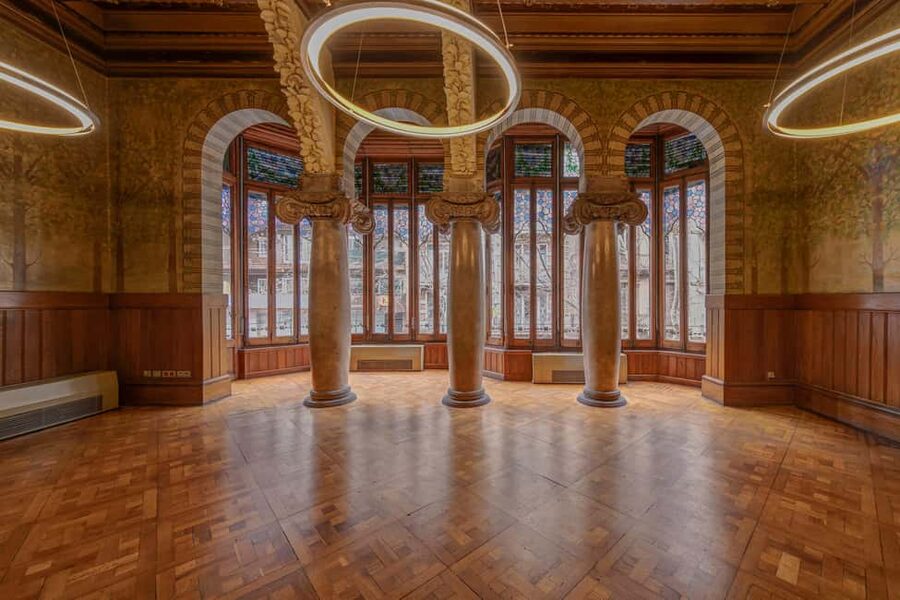
This palace sits on Diagonal Avenue, in the Catalan heartland of Barcelona’s Modernisme story. The big idea is simple: in 1902, the Baron de Quadras commissioned Josep Puig i Cadafalch to reform a house he owned there. The Baron wanted the building to look dramatic and to reflect his new nobiliary status, not quietly, but with visual confidence.
That purpose shows up fast when you enter. The architecture and decoration are not subtle. You get the sense of a Catalan palace with gothic echoes, but then color, ceramics, and ornamentation start pulling the mood in a different direction, toward an Islamic-influenced aesthetic. The result is a building that can feel both theatrical and intimate at the same time, like a private stage set.
What I like about this approach is that it makes Barcelona Modernism feel personal. This is not just a style lesson. It is the story of a real person, a real commission, and a real desire to be seen.
Why the guided format works (and what it means for your time)
The visit is about one hour, and that timing matters. In a short tour, you do not need to be an architecture expert to get something out of it. The guide gives you a structure for what to notice first, what to connect, and what details you might miss if you wandered alone.
You also have the benefit of a live guide in Spanish or English, which changes the experience compared with reading placards. A guide can point out which elements are doing the artistic work, not just what they are called. That is especially helpful in a building where decoration combines multiple influences and styles.
Group size is not stated, so I cannot promise how crowded it will feel. But for an hour in a palace interior, I treat it like a “look, learn, then move on” kind of visit. If you like deep meditation in one room, you may want to pair this with more time outside afterward in the neighborhood.
Other things to see around Barcelona
- Barcelona: Sagrada Familia Entry Ticket with Audio Guide
★ 4.6 · 105,312 reviews - Barcelona: Park Güell Admission Ticket
★ 4.4 · 76,534 reviews - Barcelona: Montjuïc Cable Car Roundtrip Ticket
★ 4.5 · 22,368 reviews
Inside the palace: mosaics, sgraffito, and ceramic color
Once you start moving through the rooms, the decorative language becomes the main character. The renovation is famous for Modernist intensity, and you see it in materials and surface work.
Here are the details you should watch for:
- Mosaics that turn walls into image-like fields
- Sgraffito, the scratch-and-layer approach that creates high-contrast texture
- Color ceramics that add shine and visual rhythm
- Multicolored Arabesque woodwork that keeps repeating patterns the eye wants to follow
I love how these elements do not just decorate. They change your sense of depth. Even when you are standing in the same spot, the surface complexity makes the room feel larger and more active.
If you are the type who likes to take photos, pay attention to angles. Patterns look sharper from slightly off-center viewpoints. Also, if the lighting is bright, colors can pop in a way that makes the mosaic work look almost three-dimensional.
The Gothic-Catalan vibe, with Islamic-influenced decoration
One reason this palace is so memorable is the emotional mix. You get repeated Gothic sculptural references, so the building can feel like a Catalan gothic palace in spirit. Then, the profusion of colored ceramics and Arabesque details shifts the mood toward an Islamic-influenced ornament style.
That blend is not random. It supports the Baron’s goal of striking appearance. The building looks like it belongs in a grand story, not a regular residential reform.
As you look, try naming what you feel rather than only what you see. Is it solemn? Is it celebratory? Does it feel like stone drama or pattern play? When you approach it that way, you start appreciating why the architect chose these specific motifs. They are doing emotional work, not just design work.
Sculptures that shape the room, not just the façade
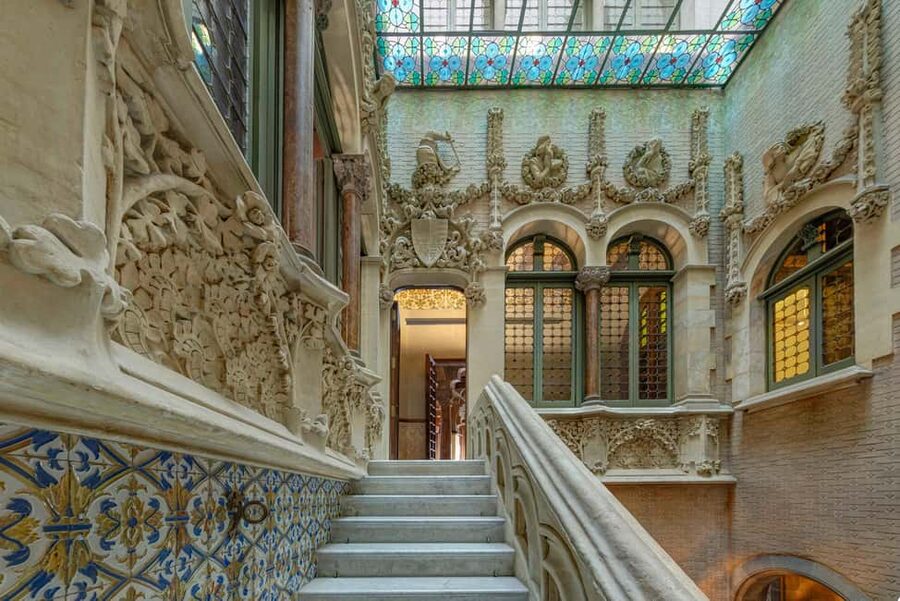
The palace also includes sculptures by Eusebi Arnau and Alfons Juyol. That matters because sculptures change how you read the architecture. They create focal points, and they help “anchor” the decorative overload so it does not feel like random ornament.
I like this part because it is the difference between decoration as background and decoration as direction. When sculptures are placed well, your eyes stop drifting. You start moving with intention, not aimlessly.
If you have time, slow down for the sculpture moments. Even in a guided hour, you can give yourself a few extra seconds at each focal area. That small pause usually pays off more than taking the quickest possible photo.
About that mixed atmosphere: what you should plan for
This is where I want to be practical. There is a clear divide in what people expect from places like this.
If you come hoping for a perfectly preserved, empty-from-the-modern-world interior, you might find the rooms can feel crowded with modern items that reduce the sense of atmosphere. In other words, it may not be a pure time-capsule experience.
On the other hand, if you treat the palace like a working interior where decoration and art elements are the star, you can still have a great visit. You can focus on the craftsmanship, the surfaces, and the sculptures that remain the core of the experience.
My advice: set your expectations based on the goal. This is a guided Modernist architecture and ornament visit. It is not a staged museum of a Baron’s life with every object recreated for nostalgia.
One ticket rarely covers it all. Here's what else is nearby.
- Barcelona: Casa Batlló Entry with Self-Audioguide Tour★ 4.7 · 25,359 reviews
- Barcelona: Hola Barcelona Public Transport Travel Card★ 4.5 · 20,985 reviews
- Barcelona: 24 or 48-Hour Hop-On Hop-Off Bus Tour★ 4.4 · 20,872 reviews
- Barcelona: Park Guell Guided Tour with Skip The Line Entry★ 4.7 · 17,563 reviews
- Barcelona Aquarium: Entry Ticket★ 4.4 · 16,717 reviews
- Barcelona in 1 Day: Sagrada Familia, Park Guell,Old Town & Pickup★ 5.0 · 13,541 reviews
Price and value for a 1-hour guided palace visit
At $22 per person for a one-hour guided tour, the value depends on what you want.
If you are the type who enjoys architecture details but does not want to guess what you are looking at, the price is easier to justify. You are paying for access to a private palace space plus a live guide to help interpret the Modernism and the layered influences.
If you would rather wander slowly with no route, $22 can feel like a constraint. The hour is short, and you will likely move at the pace of the group and the guide’s timing.
So here is the simple math I use:
- If a guide helps you notice details and you enjoy surface craft, this is a good deal.
- If you want a long, unhurried self-guided meander, look at whether you can spend extra time in the area afterward and use this as a quick architecture stop rather than your main event.
Best fit: who will love this most
This tour is a strong match if you:
- Like Modernisme and want one compact interior experience
- Enjoy mosaic, ceramic, and texture work, not only big architectural silhouettes
- Want a guided explanation in Spanish or English
- Appreciate a building commissioned for a specific purpose, not a generic landmark
It may be less satisfying if you:
- Want an interior that feels completely frozen in the past
- Plan to spend the whole hour filming or hunting for uninterrupted photo angles
- Prefer long museum-style wandering without time pressure
If you fit the first group, you will likely leave feeling like Barcelona gave you a fresh, more personal slice of its Modernist creativity.
Should you book the Palau Baró de Quadras guided tour?
I would book it if your goal is a focused, one-hour Modernist interior with strong decorative craftsmanship, guided interpretation, and easy access. At $22, it is priced like a “worth it if you care about details” stop, not a huge sightseeing commitment.
Skip it or reconsider if your top priority is an untouched, fully period-perfect atmosphere for photos. You can still appreciate the art and architecture, but your expectations need to be aligned with what the interior feels like in practice.
If you are building a Barcelona itinerary around Modernisme, this is a smart add-on. It gives you private-palace energy without eating a whole afternoon.
FAQ
How long is the Palau Baró de Quadras tickets and guided tour?
The tour lasts about 1 hour.
What is included with the ticket?
A guided tour is included.
How much does it cost per person?
The price is listed as $22 per person.
What languages are the live tours offered in?
The live tour guide is available in Spanish and English.
Is the meeting point fixed?
The meeting point may vary depending on the option booked.
Is the tour wheelchair accessible?
Yes, the experience is wheelchair accessible.
Can I cancel for a full refund?
Yes, free cancellation is offered if you cancel up to 24 hours in advance.
Is there a pay later option?
Yes, you can reserve now and pay later, so you pay nothing today.
Do tours run at different start times?
Yes, you should check availability to see starting times for the 1-hour visit.
The latest to open for booking



Tickets & Entry Passes, side by side.
Sagrada Familia Entry Ticket with Audio Guide
Read our review →

Sagrada Familia Skip-the-Line Entry Ticket & Tour
Read our review →
FC Barcelona Museum “Barça Immersive Tour” Ticket
Read our review →
Park Guell Guided Tour with Skip the Line Ticket
Read our review →