
Reviewed · GOTHIC QUARTER WALKS
Barcelona & Gothic to Modern. Regular Tour
Barcelona’s buildings teach politics and power.
This Barcelona architecture walk is interesting because it tracks the city from Roman roots to modern planning, using architect Enric Miralles as your lens. I also like the small-group setup, which helps the guide go beyond names and actually show you how to look. One drawback to plan for: this tour is more architecture-thinking than casual sightseeing, so you will get the most if you enjoy terminology, timelines, and close observation.
You start near Barcino Sculpture at Plaça Nova, then you move through a sequence of major stops: Mercado de Santa Caterina, Basilica de Santa Maria del Mar, Catedral de Barcelona, and MUHBA Temple d’August. The whole experience runs about 3 hours, is guided in English, and uses a mobile ticket so you are not hunting for paper. With a cap of 20 travelers, it stays focused, not a shuffle through landmarks.
What makes it feel different is the stated goal: you are not just touring buildings, you are learning how to see Barcelona through Miralles’s methods. The route includes an architecture microguide and even includes market fieldwork at the end, where you check the approach in real life, not just in theory.
In This Review
- Quick hits before you go
- The Miralles lens: why this Gothic to Modern walk feels “about more than style”
- Meeting at Plaça Nova: start time, pacing, and what the first 30 minutes teaches you
- Mercado de Santa Caterina: market fieldwork and why this stop changes how you see everything
- Basilica de Santa Maria del Mar: learning Gothic surroundings without getting stuck in trivia
- Catedral de Barcelona: seeing how power, faith, and planning leave physical marks
- MUHBA Temple d’August: when Roman Barcelona becomes a visible part of your walk
- La Ribera and the Gothic streets: how Pia helps you spot layers like an architect
- Microguide + method: what you carry with you after the last stop
- Price and value: what you are really paying for
- Should you book Barcelona Gothic to Modern?
- FAQ
- How long is the Barcelona Gothic to Modern Regular Tour?
- Is the tour offered in English?
- Where does the tour start, and what time does it begin?
- What stops are included on the route?
- Do I get a mobile ticket?
- What is the maximum group size?
- Are service animals allowed?
- What happens if the tour is canceled due to poor weather or the minimum number of travelers not being met?
Quick hits before you go
- Miralles as your guidebook in human form: the tour uses Enric Miralles’s ideas to connect architecture with history, politics, and cultural imagination.
- Architect-led teaching, with room to adapt: the guide Pia, an architect and lecturer, can match the pace to what your group wants to understand.
- Gothic and La Ribera quarters on foot: you get a walking experience built for noticing layers, not just taking photos.
- A practical ending at the market: you do fieldwork to practice how Miralles’s way of reading space works.
- Tight group size: up to 20 people means more interaction and fewer lost moments.
The Miralles lens: why this Gothic to Modern walk feels “about more than style”

The tour’s big concept is simple to explain and harder to fake in practice: architecture is never only about aesthetics. You are guided to see the city as a record of shifting power, beliefs, and imagination, with each era leaving visible traces in streets, structures, and public decisions.
That is where Enric Miralles comes in. The walk is framed as an initiation that stays loyal to his way of talking about architecture, including the idea that real buildings come from complex reality, not slogans. Instead of treating Barcelona’s changes as a neat timeline of styles, you are encouraged to connect what you see to why it happened.
I like that you cover multiple “turning points” beyond the obvious famous landmarks. The story arc moves through Roman Barcelona, then the Carolingian era, the post-Franco era, Olympic Barcelona, and finally the era connected to el forat de la vergonya, the hole of shame. Even if you know only a little, the sequence gives you a sense that modern Barcelona was built through decisions, constraints, and tradeoffs, not just artistic genius.
Meeting at Plaça Nova: start time, pacing, and what the first 30 minutes teaches you
You meet at Barcino Sculpture, Plaça Nova, 40, Ciutat Vella with a 10:30 am start. Being based in central Ciutat Vella matters because it compresses your walking time and keeps the route feeling like a true neighborhood lesson, not a bus-to-sights routine.
Plan on a 3-hour rhythm that stays active. This is not the kind of tour where you bounce from one spot to another with long breaks. You will want good walking shoes, because the value is in the connections between stops, and those connections live in the streets between them.
Because the maximum group size is 20, you can usually hear well and ask questions. Still, you should expect some density early on, because the guide sets the framework for how to read the buildings you will see next. If you like starting with a “method,” this tour gives you one quickly.
Also, the guide uses a mobile ticket, which is handy when you are juggling other parts of your day. Just make sure you keep the ticket accessible on your phone, since that is what you will rely on at check-in time.
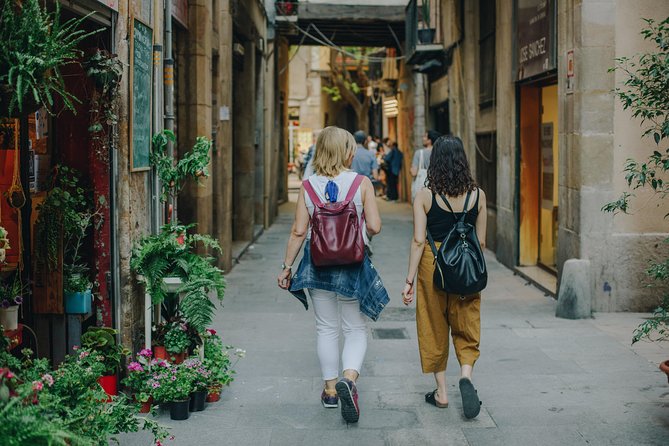
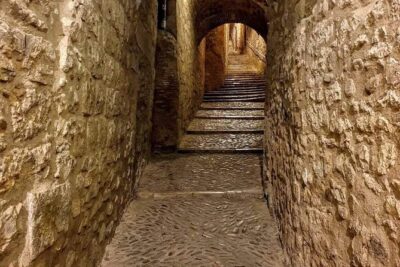
Get lost in the medieval lanes
- Barcelona all included: Sagrada, Park Güell, Montjuic & Gothic
★ 5.0 · 2,169 reviews - Barcelona Gothic Quarter Tapas & Taverns Food & Wine Tour
★ 5.0 · 1,470 reviews - Barcelona: Old Town and Gothic Quarter Walking Tour
★ 4.8 · 1,393 reviews
Mercado de Santa Caterina: market fieldwork and why this stop changes how you see everything
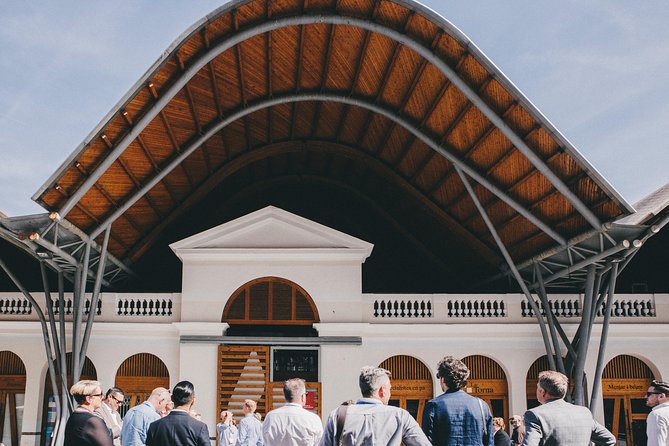
The first named stop is Mercado de Santa Caterina. A market can be a casual photo stop on other tours, but here it is treated as a place where real urban life and design decisions meet.
The tour includes architecture fieldwork at the market, where you check Miralles’s methods and how the approach works in practice. That matters, because it shifts you from passive watching to active noticing. You start learning to ask better questions while you are standing in the space, not back in your hotel room trying to remember details.
What you should take from this stop is the tour’s underlying message: architecture lives in daily routines. Even if you do not care about the technical jargon, the market setting makes the ideas tangible. You can see how design shapes movement, visibility, and how people use space.
A small practical note: markets are great for learning, but also a real-world environment. If you are sensitive to crowds or noise, come prepared for that, because this is an area where people actually go, not an empty courtyard created for visitors.
Basilica de Santa Maria del Mar: learning Gothic surroundings without getting stuck in trivia
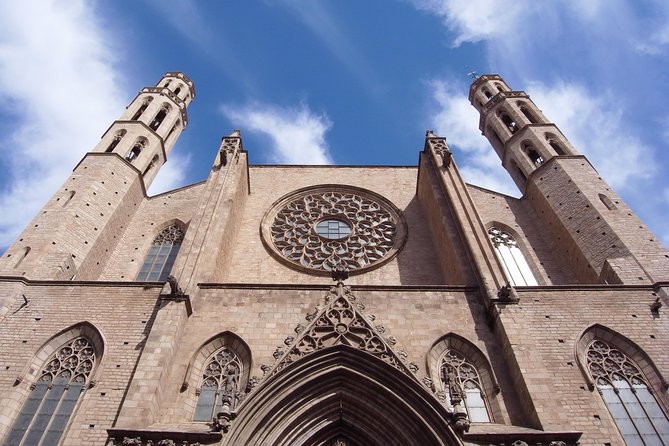
Next comes Basilica de Santa Maria del Mar. This stop is a strong fit for the tour’s promise to move through Gothic and La Ribera with context, not just surface facts.
Instead of turning this into a checklist of architectural elements, the walk treats religious and civic buildings as part of a broader urban story. You are guided to connect what you see with the longer shifts in Barcelona: how communities organize themselves, how values show up in stone and space, and how the city’s identity hardens over time.
I like this approach because it prevents the common problem of architectural tours becoming either too academic or too shallow. Here, you get the historical and political frame, but you are still walking your way through the physical city. You leave stops with “why” in your head, not only “what.”
Catedral de Barcelona: seeing how power, faith, and planning leave physical marks
Then you reach Catedral de Barcelona. Cathedrals can easily become the “big obvious photo” moment. This tour tries to prevent that by keeping the focus on the way big institutions reflect larger forces.
You will be encouraged to think about how architecture changes through time, especially when political moments reshape what gets built, what gets renovated, and what gets prioritized. Since the broader route spans eras like the post-Franco period and Olympic Barcelona, the cathedral fits into the bigger theme of continuity and change.
One thing I appreciate is that this is not presented as a simple story of progress. The tour language pushes you to face the complex reality behind built form, including contradictions and compromises. That is a more honest way to look at a city like Barcelona, where different eras are stacked in the same streets.
If you are the type who likes to understand the logic behind major landmarks, this stop will land well. If you prefer a lightweight, story-only walk, it may feel more structured than you expected.
MUHBA Temple d’August: when Roman Barcelona becomes a visible part of your walk
The final named stop is MUHBA Temple d’August. This is where the Roman thread feels concrete in your route. Since the tour’s arc begins with Roman Barcelona, ending with MUHBA Temple d’August helps you feel the continuity of the city across centuries.
What you gain here is perspective. It is easy to think of historic cities as a set of eras in separate compartments, but the point of this walk is that the layers overlap and talk to each other. Even if you are not a Roman history buff, the presence of Roman remains within a modern city helps the main idea click: Barcelona’s present is literally built over and around what came before.
This stop also supports the tour’s method emphasis. You are not just hearing facts, you are using a way of looking. If you did the market fieldwork with focus, you should notice the same kind of reading process applied here.
One ticket rarely covers it all. Here's what else is nearby.
- Barcelona: Sagrada Familia Entry Ticket with Audio Guide★ 4.6 · 105,312 reviews
- Barcelona: Park Güell Admission Ticket★ 4.4 · 76,534 reviews
- Barcelona: Casa Batlló Entry with Self-Audioguide Tour★ 4.7 · 25,359 reviews
- Barcelona: Montjuïc Cable Car Roundtrip Ticket★ 4.5 · 22,368 reviews
- Barcelona: Hola Barcelona Public Transport Travel Card★ 4.5 · 20,985 reviews
- Barcelona: 24 or 48-Hour Hop-On Hop-Off Bus Tour★ 4.4 · 20,872 reviews
La Ribera and the Gothic streets: how Pia helps you spot layers like an architect
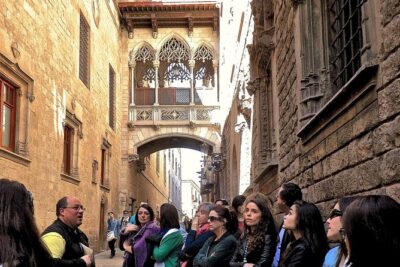
The walk does not only visit famous buildings. It is designed to explore the Gothic and La Ribera quarters, meaning the streets and side spaces matter.
A standout in the experience is the teaching style. The guide Pia comes through as an architect and university-level lecturer, and that shows in how she explains ideas. In particular, I like that she can use tools like charts to make long timelines feel manageable. When you are dealing with eras from Carolingian Barcelona to the Olympic era and beyond, visual structure helps a lot.
Another practical plus: the tour can work across different interest levels. In small groups, Pia has been able to tailor explanations, including translating a few words for a non-English speaking guest. That tells me the guide is paying attention to real group needs, not delivering a one-size monologue.
Do note one limitation. Some people expect a warm, narrative, pop-history style. This tour is more about learning how to look, which can mean more terminology and more “method talk.” If you enjoy that, you will feel satisfied quickly. If you want only storytelling, you may have to work a bit to stay engaged.
Microguide + method: what you carry with you after the last stop
You get an architecture microguide, and it is not just a souvenir. The value is that it supports the way the tour teaches you to observe, so you can continue the process after the walk ends.
The tour also connects history and politics to built form. That connection changes what you notice next day when you walk around on your own. You stop scanning only for recognizable shapes and start seeing decisions, constraints, and layers of meaning.
The market ending adds a nice “practice session” feeling. You end with fieldwork, so the lesson is not sealed in lectures. You have already tried the method in the place where design meets daily use.
Price and value: what you are really paying for
You are not just paying for access to four major sites. The real value is the combination of an architect-led guide, a small group, and a structured approach based on Enric Miralles.
In other words, the tour works best when you want more than photos. You want a way to interpret what you are seeing, so you can explore Barcelona with better eyes afterward. If that is your style, this will feel like time well spent.
If you want the cheapest way to check off landmarks, there are plenty of options. But if you care about understanding, including how different eras shaped what you see today, this tour is aimed directly at that.
Should you book Barcelona Gothic to Modern?
Book it if you:
- Like architecture and want a structured way to read the city.
- Enjoy learning through context, including politics and cultural imagination.
- Want a tour small enough to ask questions and stay engaged.
Consider skipping or pairing it with something lighter if you:
- Prefer a casual, purely storytelling sightseeing walk with minimal architecture talk.
- Want only an intro overview without timelines, method, and technical vocabulary.
If you do book, go in with a simple mindset: look closely, ask questions, and treat the market fieldwork like your chance to practice. That is where the tour really earns its keep.
FAQ
How long is the Barcelona Gothic to Modern Regular Tour?
The tour lasts about 3 hours.
Is the tour offered in English?
Yes, it is offered in English.
Where does the tour start, and what time does it begin?
It starts at Barcino Sculpture, Plaça Nova, 40, Ciutat Vella, 08002 Barcelona, Spain, and the start time is 10:30 am.
What stops are included on the route?
The tour includes Mercado de Santa Caterina, Basilica de Santa Maria del Mar, Catedral de Barcelona, and MUHBA Temple d’August.
Do I get a mobile ticket?
Yes, the tour includes a mobile ticket.
What is the maximum group size?
The tour has a maximum of 20 travelers.
Are service animals allowed?
Yes, service animals are allowed.
What happens if the tour is canceled due to poor weather or the minimum number of travelers not being met?
If it is canceled due to poor weather, you will be offered a different date or a full refund. If the minimum number of travelers is not met, you will be offered a different date or a full refund.
The latest to open for booking



Gothic Quarter Walks, side by side.
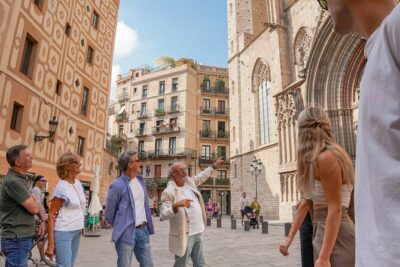
Barcelona all included: Sagrada, Park Güell, Montjuic & Gothic
Read our review →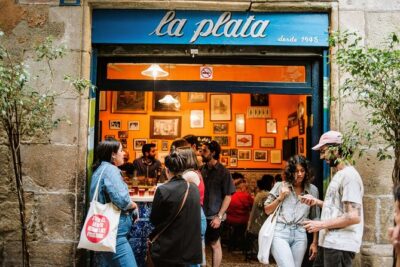
Barcelona Gothic Quarter Tapas & Taverns Food & Wine Tour
Read our review →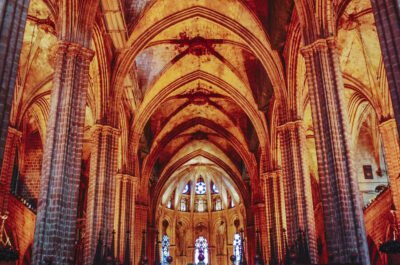
Barcelona Old Town & Gothic Quarter Small Group Tour
Read our review →
Ramblas, Old Town, Gothic and Gaudi Architecture Walking Tour
Read our review →
El Born and Gothic Quarter Wine & Tapas Bar Tour
Read our review →
El Born Food Walking Tour with Tapas and Drinks
Read our review →
Kids and Family Gothic Quarter Walking Tour in Barcelona
Read our review →Where else this one turns up