
Reviewed · GOTHIC QUARTER WALKS
Gothic Quarter Insights & Tapas Experience
Barcelona’s medieval core rewards slow wandering. This walk through the Gothic Quarter is interesting because it stitches together Roman clues, medieval squares, and big church energy with clear, story-driven stops, plus pintxos and a drink to keep you going. I especially like the multilingual guide approach, and I also like how the route gives you an instant sense of where things are, so your later exploring feels smarter. One thing to consider: you are on your feet for about two and a half hours, and if you expect a low-walking, sit-and-stare tour, this one may feel a bit brisk.
You meet at the Lamaro Hotel (Av. de la Catedral, 7) at 3:30 pm and the tour ends back at the same spot. The group stays small, max 20 people, so you can actually hear the guide and keep up. And at $54.06 per person, you get a professional guide plus a snack-and-drink finish, which is a very solid value for a focused afternoon.
Best of all, the stops are practical landmarks you can revisit later. You will see everything from the Plaça Nova Roman-era references to MUHBA Temple d’August’s surviving columns, and then you end with a classic pinxo moment. The main drawback I noticed in the overall vibe is that this is more architecture-and-urban-history than full-on legends, so if that is what you crave most, you might want extra time to hunt down stories on your own after.
In This Review
- Key highlights worth aiming for
- Gothic Quarter in 150 minutes, without the overwhelm
- The meeting point and how to find your guide at 3:30 pm
- Plaça Nova and the Barcino alphabet right where Rome still shows
- Catedral area and the Portal del Bisbe history angle
- Casa de l’Ardiaca: church hierarchy turned courtyard and terrace
- Plaça Sant Felip Neri: a tiny square with serious street history
- Plaça del Pi and the artisan squares around a Gothic basilica
- Plaça del Rei: the medieval royal palace pocket of calm
- MUHBA Temple d’August: Roman columns that survived the ages
- Santa Maria del Mar: the neighborhood’s cathedral-feeling Gothic masterpiece
- Carrer de Montcada: a medieval civic architecture corridor
- The pintxo and drink stop: why food belongs at the end
- What timing feels like on the ground (and how to plan around it)
- Price and value: what $54.06 actually covers
- Who this tour suits best, and who should think twice
- Should you book the Gothic Quarter Insights and Tapas Tour?
- FAQ
- How long is the Gothic Quarter walk?
- What food and drinks are included?
- Where do I meet, and where does it end?
- What time does the tour start?
- How big is the group?
- Is there free cancellation?
Key highlights worth aiming for
- Roman Barcino breadcrumbs at Plaça Nova and the Temple d’August columns at MUHBA
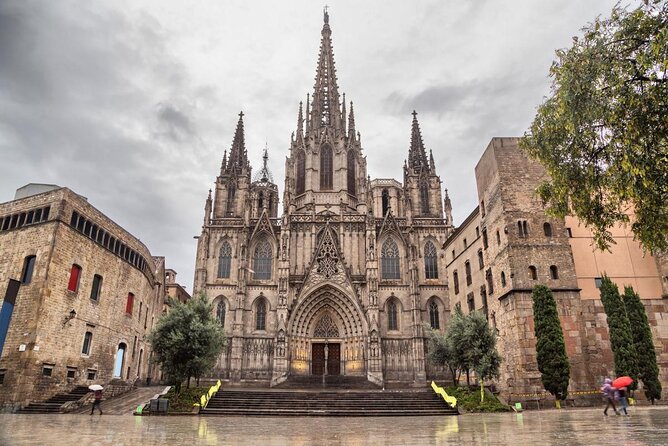
- Catalan Gothic landmarks like Plaça del Pi and Santa Maria del Mar
- Medieval power and daily life at Plaça del Rei and around the churchy squares
- Guided pacing that keeps you oriented with frequent, short stops
- Food that fits the walk: one pintxo and one drink included for a proper recharge
- Small group feel with a maximum of 20 people and a 3:30 pm start
Gothic Quarter in 150 minutes, without the overwhelm
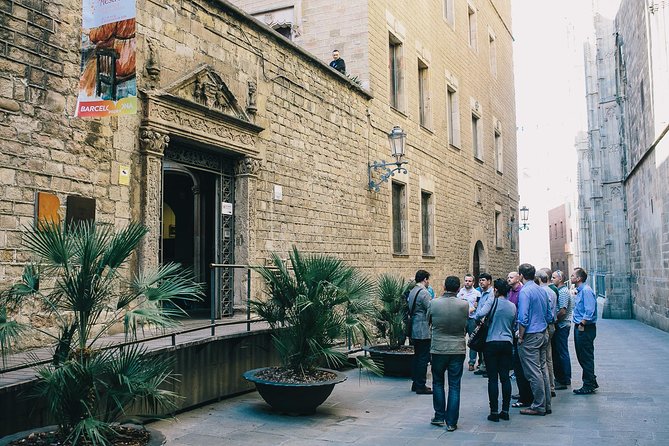
This tour is built for orientation. You start in the medieval epicenter, then you keep walking through layers of time, Roman, medieval, and Catalan Gothic, without anyone needing you to study a map for hours. That makes it a great first or early visit, because after the tour you know what street leads where.
The pace is also tour-smart. Each stop is brief, then you move, which means you get lots of payoff without spending your whole afternoon stuck in one square. And because the group is limited to 20, the guide can keep attention and steer you toward the details that matter.
The meeting point and how to find your guide at 3:30 pm
You begin at Lamaro Hotel Barcelona on Av. de la Catedral, 7, in Ciutat Vella. The tour starts at 3:30 pm and loops back to the meeting point, so you are not stuck wandering toward a new pickup later.
Plan to arrive a few minutes early. One guest problem in past groups was simply missing the moment when they were late, so being on time protects your experience. And because the area can feel busy, I recommend you spot your guide quickly by using any visible marker they use, like a clearly identifiable umbrella some guides have carried in earlier tours.
Also, wear comfortable shoes. This is a walking route in narrow streets and square hopping, so your feet will do the work.
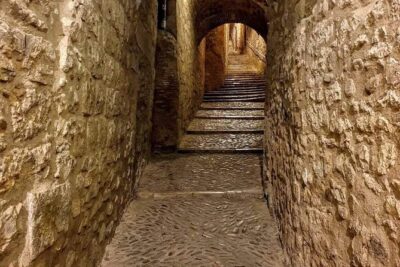
Get lost in the medieval lanes
- Barcelona all included: Sagrada, Park Güell, Montjuic & Gothic
★ 5.0 · 2,169 reviews - Barcelona Gothic Quarter Tapas & Taverns Food & Wine Tour
★ 5.0 · 1,470 reviews - Barcelona: Old Town and Gothic Quarter Walking Tour
★ 4.8 · 1,393 reviews
Plaça Nova and the Barcino alphabet right where Rome still shows
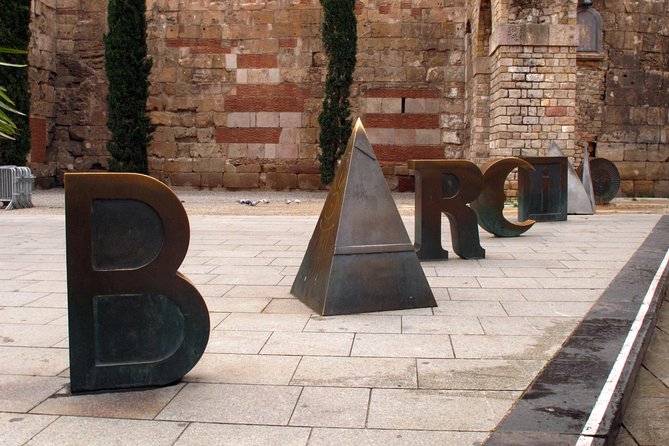
Plaça Nova is a fun starting punch because it is playful, not just solemn. Almost touching the wall of the former Roman city, you will see the giant letters spelling out Barcino, the principal name tied to the ancient Roman settlement that became present-day Barcelona.
These letters were created by Joan Brossa, and the materials matter for the feel of it. Six are made of bronze and one is aluminium, each bolted to the ground. It is a clever way to teach a big idea without lecturing, Barcelona did not start as a Gothic maze. It started as a Roman city, and the stones are still around you.
Why this stop works early: it sets the theme, Barcelona’s “old town” is not one era. It is a stack of eras, with the Roman base still influencing the layout.
Catedral area and the Portal del Bisbe history angle
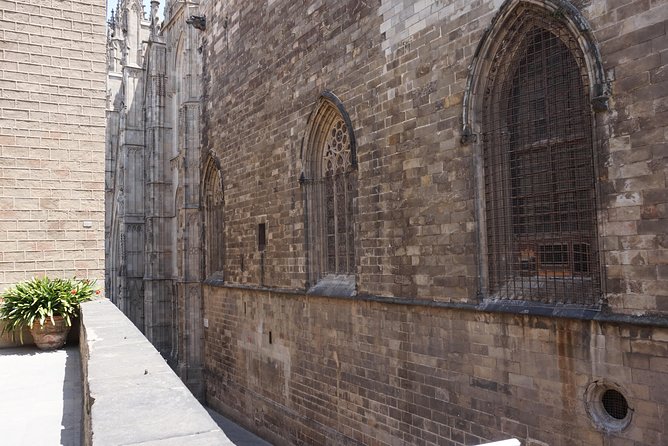
Next comes the cathedral precinct zone, around the Catedral de Barcelona and the Palace of the Bishop area. This is where the story shifts from Roman foundations into medieval power, because the place is tied to the walled city and its surviving Roman walls.
You will also hear about New Square, the area in front of the Roman Porta Praetoria, known locally as the Portal del Bisbe. New Square was created in 1355, when water was channeled from Collserola and buildings were removed to face the portal. That is a very “Barcelona” kind of change, practical engineering reshaping what people could see and move through.
Drawback to keep in mind: this part can be visually crowded, so come ready to focus on architectural cues your guide points out rather than trying to photograph everything at once.
Casa de l’Ardiaca: church hierarchy turned courtyard and terrace
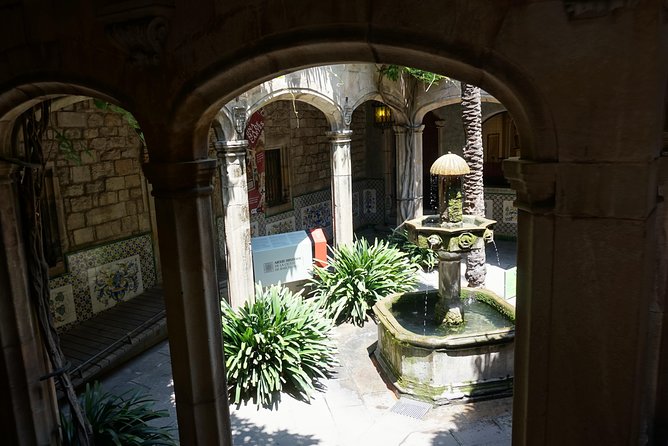
Casa de l’Ardiaca gives you a calmer, more layered look at medieval and Renaissance changes. You will hear how it served as a residence for ecclesiastical hierarchy starting in the 12th century, then went through alterations, including work in the early 16th century that connected it with another dean’s residence.
The courtyard and decoration details are the payoff. The building features a porticoed central courtyard, and you will see Renaissance-style decorations that tie into a flamboyant Gothic base. Then you get a staircase up toward the terrace and balcony, described as Romeo and Juliet style, which helps you picture how these spaces were designed for human scale and dramatic sightlines.
This stop is also a nice mental breather. After more street-level moments, Casa de l’Ardiaca gives you a sense of how medieval institutions lived inside the Gothic Quarter.
Plaça Sant Felip Neri: a tiny square with serious street history
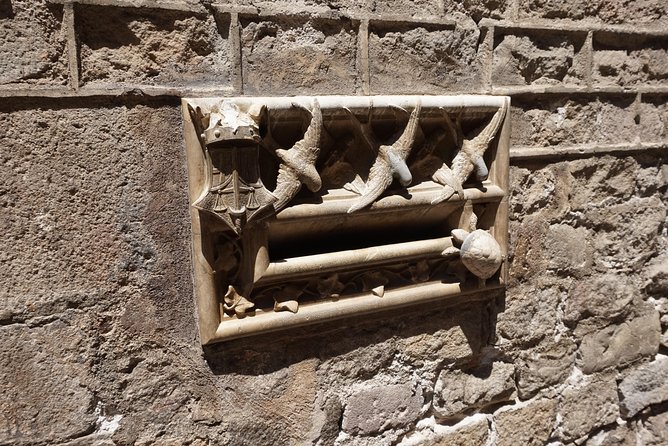
Plaça Sant Felip Neri is one of those surprises you remember. It is a narrow, labyrinth-stretch that opens into a tiny square with a fountain, overlooked by the baroque church of Sant Felip Neri.
What makes it interesting is the human layer. The sides of the area connect to former guild buildings, once home to shoemakers and coppersmiths. Those guilds moved here from Carrer de la Bòria and Carrer de la Corribia, and that kind of detail makes the quarter feel lived-in, not just preserved.
If you like street-level history, this is a strong stop. If you only care about huge monuments, it can feel small, but small is the whole point here.
Small plates, several bars, one night
- Montserrat Half-Day Tour with Tapas and Gourmet Wines★ 5.0 · 7,359 reviews
- Montserrat & Cogwheel Train, Gourmet Wine Tasting & Tapas/Lunch★ 5.0 · 6,290 reviews
- Barcelona Tapas and Wine Experience Small-Group Walking Tour★ 5.0 · 5,804 reviews
- Montserrat with Black Madonna & Medieval Winery with Tapas/Lunch★ 5.0 · 5,209 reviews
- Barcelona: Tapas Walking Tour with Food, Wine, and History★ 4.8 · 4,261 reviews
- Barcelona Paella Cooking Class with Market Visit, Tapas & Sangria★ 5.0 · 2,531 reviews
Plaça del Pi and the artisan squares around a Gothic basilica
Then you step into Placa del Pi, where the Gothic basilica and surrounding squares create one of the quarter’s most charming corners. The old cemeteries around the 14th-century church have turned into small squares, where painters and artisans exhibit works.
This stop is a good place to slow down for a minute. You can look at the church side-by-side with the street life around it, and it helps you understand why this quarter is still a working neighborhood, not only a museum zone.
Practical tip: if you want a better sense of the street geometry, stand at the edges of the squares and look both ways down the narrow streets. The guide will help, but your own sightline matters here.
Plaça del Rei: the medieval royal palace pocket of calm
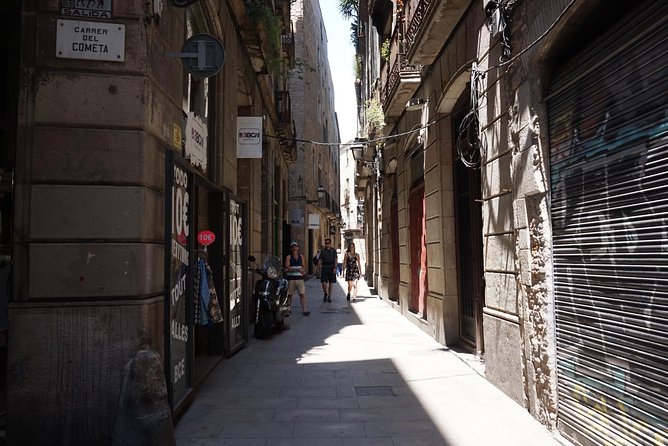
Plaça del Rei is arguably the medieval architectural ensemble that best sums up the quarter’s mood. You will see how the royal palace, the Palau Reial Major, and surrounding buildings enclose a harmonious, peaceful square with medieval grandeur.
This is not a place that feels like a stage set. It feels like the city kept its sense of center. The space helps you understand medieval civic life, because power and daily street life were not always separated into totally different worlds.
If you are into photography, bring your patience. This square can be busy, but it gives you strong angles because the buildings wrap the space rather than opening it up.
MUHBA Temple d’August: Roman columns that survived the ages
MUHBA Temple d’August is one of the route’s best surprises because it feels like a quiet secret you can touch. Inside a small medieval courtyard on Carrer Paradís, you will see the four columns from the Temple of Augustus still standing after more than 2,000 years.
That age is not a throwaway fact. It changes your brain’s scale of the city. You are walking in a medieval quarter, yet the Roman architectural remnants are right there, sturdy and physical.
This stop is also efficient for history lovers. You do not need an archaeology degree to “get it,” because the visual is immediate: four columns, old beyond old, framing the next centuries you are about to see.
Santa Maria del Mar: the neighborhood’s cathedral-feeling Gothic masterpiece
Basilica de Santa Maria del Mar is often called the real cathedral of the Old Town because of how it was founded. It was constructed in Medieval times by people from the neighborhood itself, not by some distant authority with no local stake.
In other words, the building tells you a social story. It is an emblem of Catalan Gothic art and a must-see stop in the Gothic Quarter because the style feels purposeful and community-driven.
When you stand here, you get a sense of why the quarter built things vertically, and why the local church mattered as a gathering place. This stop also works well as a payoff after the smaller squares, because the scale makes the route feel complete.
Carrer de Montcada: a medieval civic architecture corridor
Carrer de Montcada is where the tour turns into a walkable textbook of medieval civic architecture. You will learn it used to be all one single street until the 19th century, when it was divided by the opening of Carrer Princesa in 1853.
The timeline cues are fun. The street starts with the Romanesque Marcus chapel from the 12th century and then continues until Plaça del Born. And the Montcada family story adds local color, including the idea that land was given to support King Ramon Berenguer IV during the conquest of Majorca.
This is a great stop if you like how architecture connects to families and politics, because you can walk the street and feel the way wealth and civic life shaped the built environment.
The pintxo and drink stop: why food belongs at the end
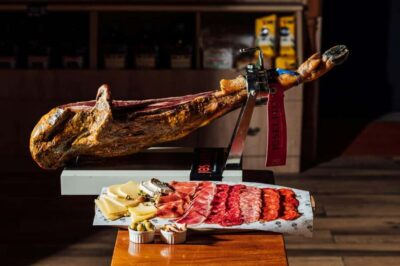
The best part of tapas culture in Barcelona is that it is not only about eating. It is about pacing your day in small steps, with conversation and a snack that keeps your feet moving.
This tour includes one pintxo and one drink, so you get a proper reset at the finish. In many cases, your included stop is where the guide’s stories land in real life, because pinxo hopping is part of the city rhythm, not a separate activity.
You will also hear the pintxo vs tapas difference in plain terms, which is useful if you are ordering on your own later. And if your guide is the type who enjoys helping you take Barcelona home, you may get extra pointers, like guidance from one past guide who helped guests choose an olive oil to bring back.
What timing feels like on the ground (and how to plan around it)
The tour runs about two and a half hours, with short time blocks at each landmark. You do not sit for long, so your day stays flexible. If you just arrived, this is a great way to get your bearings fast, especially if you are coming from a cruise day or you have only a free afternoon.
The 3:30 pm start is also smart. You are catching late-day light on stone facades, and you are not burning your morning trying to squeeze in too much. Just keep one thing in mind: squares can get crowded, and it can be hard to hear over street noise unless you stay close to your guide.
Price and value: what $54.06 actually covers
At $54.06 per person, this is not just a free-for-all walking tour. You are paying for a professional guide, multiple languages supported, and a snack finish. And importantly, the stops on the route are listed as admission ticket free, meaning you are not likely hit with surprise entry fees for these particular sights.
That makes the math feel fair. You get a structured route through key Gothic Quarter landmarks, you get food and drink to keep the afternoon from collapsing into “just one coffee,” and you get context that makes the stones make sense.
If you are traveling solo, a small-group format like this can also feel more efficient. You get orientation without needing to do research for nine separate mini stops.
Who this tour suits best, and who should think twice
Book this if you:
- Love medieval architecture and want your head to connect Roman to Gothic to Catalan Gothic quickly
- Want an easy way to learn where streets and squares are, so your later self-guided wandering feels confident
- Like group tours with a social vibe, since you meet other people as you walk
Skip or pair it with other activities if you:
- Want long stays at interiors or a slow museum-style visit, because this route is short-stop, move-on pacing
- Expect lots of folklore and legends over building facts, since the focus leans more toward structure and urban history than pure storytelling
Should you book the Gothic Quarter Insights and Tapas Tour?
I think it is a strong booking for a first afternoon in Barcelona’s Gothic Quarter. The route hits big reference points you can revisit later, it stays small enough to stay listenable, and the included pintxo and drink keep the experience from feeling like sightseeing-only.
If you show up on time and wear good shoes, you will leave with a clear mental map and a bunch of “Oh, that explains everything” moments about how the city was layered over time.
FAQ
How long is the Gothic Quarter walk?
It lasts about two and a half hours (approximately).
What food and drinks are included?
You get one pintxo and one drink as part of the experience.
Where do I meet, and where does it end?
You meet at Lamaro Hotel Barcelona, Av. de la Catedral, 7 (Ciutat Vella). The tour ends back at the same meeting point.
What time does the tour start?
The start time listed is 3:30 pm.
How big is the group?
The tour has a maximum of 20 travelers.
Is there free cancellation?
Yes. You can cancel for a full refund if you cancel at least 24 hours in advance of the experience’s start time, and cancellation is free up to that point.
The latest to open for booking


Gothic Quarter Walks, side by side.
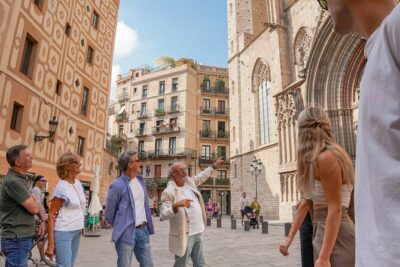
Barcelona all included: Sagrada, Park Güell, Montjuic & Gothic
Read our review →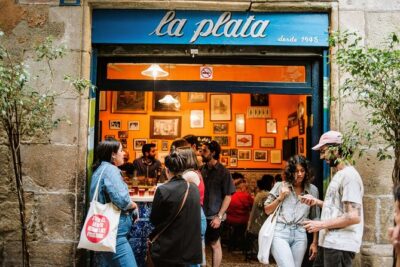
Barcelona Gothic Quarter Tapas & Taverns Food & Wine Tour
Read our review →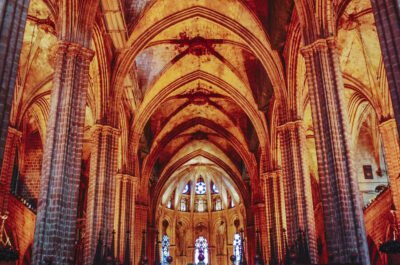
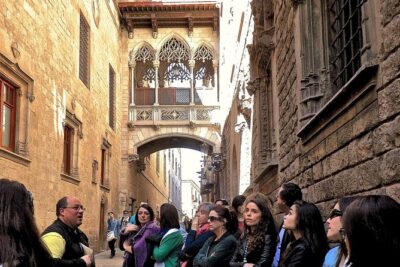
Barcelona Old Town & Gothic Quarter Small Group Tour
Read our review →
Ramblas, Old Town, Gothic and Gaudi Architecture Walking Tour
Read our review →
El Born and Gothic Quarter Wine & Tapas Bar Tour
Read our review →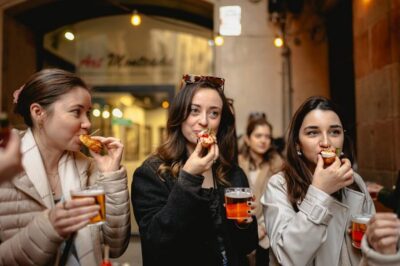
El Born Food Walking Tour with Tapas and Drinks
Read our review →
Kids and Family Gothic Quarter Walking Tour in Barcelona
Read our review →Where else this one turns up