
Reviewed · GOTHIC QUARTER WALKS
Private Barcelona Old Town Walking Tour: Gothic Quarter & Born
Gothic and Born come together fast on foot. This private 3-hour walk gives you a guided route in English and lots of quick stops where you can connect Roman, Jewish, and medieval Barcelona. I love the tight flow from Plaza de Catalunya to Las Ramblas, and I love that the guide brings historical documents and pictures so today’s streets make sense fast.
The only real catch is that Santa Maria del Pi and the MUHBA Roman ruins museum have admission tickets not included, so you may want to plan for a quick decision at the time. Also, many stops are brief, which is perfect for first-time orientation, but it can feel short if you want long, quiet time inside buildings.
In This Review
- Key Highlights You Will Feel On This Walk
- Why This Gothic Quarter and Born Walk Works in 3 Hours
- Starting at Passeig de Gràcia, Ending in El Born
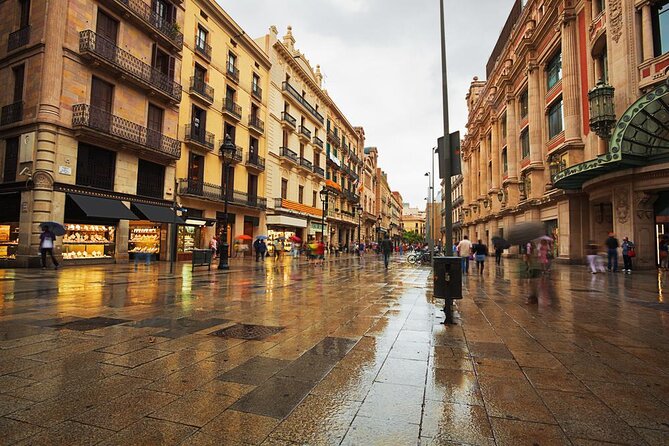
- Plaza de Catalunya to Las Ramblas, the City’s Spine
- Boqueria and Petritxol, Where Food Culture Becomes History
- Santa Maria del Pi, the Call, and the Memory in Plaça de Sant Felip Neri
- Roman Walls to Plaça del Rei, the Thickest Layer of the City
- MUHBA Ruins and the Columns of the Temple of Augustus
- Pont del Bisbe, City Hall, and Generalitat: Power in Stone
- Castellers and Gaudí Lamps: From Tradition to Design
- Santa Maria del Mar and Mercat del Born, the Born’s Best Story Turns
- Price and Value for a Private 3-Hour Tour
- Who This Tour Best Suits
- Should You Book This Private Barcelona Old Town Walking Tour?
- FAQ
- How long is the Private Barcelona Old Town Walking Tour?
- Where is the meeting point and when does the tour start?
- Where does the tour end?
- Is this tour private?
- What language is the tour offered in?
- Is there a mobile ticket?
- Are service animals allowed?
- Which stops have admission tickets that are not included?
- What is the cancellation policy?
Key Highlights You Will Feel On This Walk
- A true Gothic Quarter to Born route built for first-time orientation, not a random checklist
- Historical comparisons on the move, using documents and pictures to connect old Barcelona to what you see now
- Roman layers plus medieval landmarks in one compact 3-hour circuit
- Jewish Quarter context at Call de Barcelona, with the 1938 bombing traces at Plaça de Sant Felip Neri
- An easy sweet ending at Patisserie Hofmann in the Born, with time to grab dessert or a drink
Why This Gothic Quarter and Born Walk Works in 3 Hours
Barcelona’s old center can feel like a maze on your own. This tour avoids that problem by moving you from major anchors to the exact side streets and plazas that explain how the city grew. You get a guided route that is practical, not showy, and it helps you understand what you are looking at instead of just spotting pretty buildings.
I also like the pace. It is a 3-hour private walking tour, so you get a clear plan without spending your whole day in transit. Most stops are free to view from the street, which means your time is spent outside, with quick introductions that put each place in context.
One more thing that matters for value: this is not only about famous stops. You also move through less expected moments, like the Call de Barcelona (the Jewish quarter area) and the Roman entrance viewpoint, so your walk feels like it covers real layers rather than only postcards.
Starting at Passeig de Gràcia, Ending in El Born
The tour starts at 4:00 pm at Apple Passeig de Gràcia, Pg. de Gràcia, 1, Eixample. This is a smart starting point because it puts you close to the transit network, and you can arrive easily. You also get a solid briefing in Plaza de Catalunya before the walk spreads out into narrower lanes.
The tour ends in the Born, at Mercat del Born, Plaça Comercial, 12, Ciutat Vella. That ending location is convenient because you are already in a great area to keep exploring, grab a drink, or simply follow your curiosity deeper into El Born’s streets.
Because it is private, you are not squeezed into someone else’s group tempo. If you have questions, you can ask them and the guide can steer the discussion to what interests you most, as long as you still stay within the walking schedule.
Get lost in the medieval lanes
- Barcelona all included: Sagrada, Park Güell, Montjuic & Gothic
★ 5.0 · 2,169 reviews - Barcelona Gothic Quarter Tapas & Taverns Food & Wine Tour
★ 5.0 · 1,470 reviews - Barcelona: Old Town and Gothic Quarter Walking Tour
★ 4.8 · 1,393 reviews
Plaza de Catalunya to Las Ramblas, the City’s Spine
You begin with a briefing in Plaza de Catalunya, right in the center of Barcelona. That first stop matters because it frames what comes next, and it gives you the mental map you will need once you hit the older, tighter streets.
Then you head to Las Ramblas, which the tour describes as a key street connecting the newer part of the city with the port. This is where you see Barcelona in motion, with the broad axis that many visitors use. Even if you already know the street, you will get a different feeling once you connect it to the longer story of where people traveled and where goods and arrivals flowed.
A short hop brings you to Font de Canaletes. It is tied to Barça celebrations, so it works as a pop-cultural anchor. The point here is not the fountain itself, it is what the fountain represents as a meeting place for locals, turning a simple landmark into a small slice of living city tradition.
Boqueria and Petritxol, Where Food Culture Becomes History
Next up is Mercat de la Boqueria, one of Barcelona’s most important markets on Las Ramblas. You get about 10 minutes here, which is just enough time to orient yourself: where the action is, what kinds of stalls dominate, and how the market fits into the wider street life.
You then walk to Carrer de Petritxol, known as the Street of Chocolate. This is a classic Barcelona mini-detour, and the short stop format works well because it lets you enjoy the vibe without losing the main route.
If food is your thing, plan for this section to be more about observation than shopping. Many market experiences are crowded and fast. With a guided pace, you can at least slow down for the few details that matter to you, like textures, aromas, and the range of what the stalls sell.
Santa Maria del Pi, the Call, and the Memory in Plaça de Sant Felip Neri
Basílica de Santa Maria del Pi is the next big stop. The key detail for planning is that admission tickets are not included. That does not stop you from appreciating the basilica from the outside, but it does mean you should decide on the spot whether you want to pay extra to go in.
From there, you enter the Call de Barcelona area, the Jewish quarter within the Gothic area. This is one of the most valuable parts of the tour because it adds more human context to the old streets. You are not only looking at architecture, you are learning how communities lived and how that life shaped what remained.
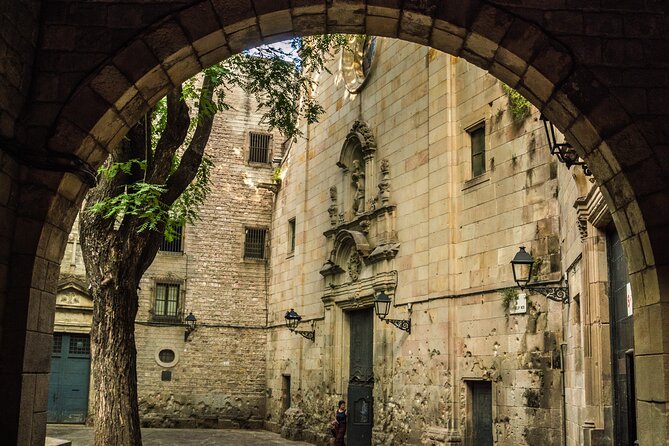
Then you reach Plaça de Sant Felip Neri, described as beautiful and sadly famous because you can still see traces of bombing from 1938. Even with a short stop, this is the kind of moment that gives weight to the rest of the walk. It also explains why the old quarters can feel both elegant and heavy at the same time.
Roman Walls to Plaça del Rei, the Thickest Layer of the City
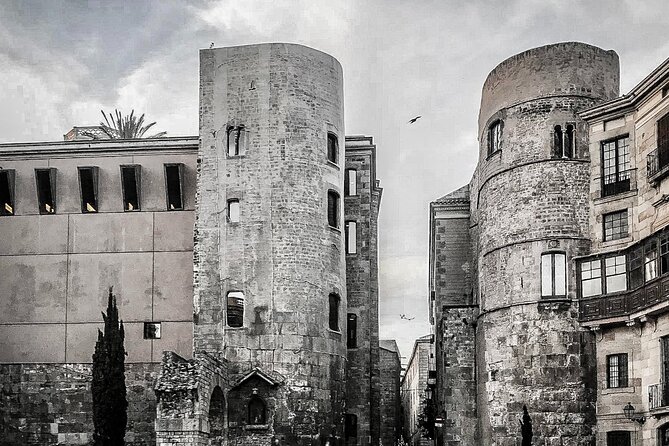
The tour moves quickly into Roman Barcelona with a look at the Roman city wall entrance. The stop is brief, but it gives you a clear signal: you are walking through a city that has been rebuilt again and again, not simply renovated once.
After that, you pause at Plaça d’Isidre Nonell, where you will see a mosaic of The Kiss. This is a different kind of cultural stop, leaning more toward art in public space than ancient ruins. It is also a nice moment to reset before the grand monuments start stacking up.
Then comes the Cathedral of Barcelona. The idea here is quick orientation rather than a long interior visit. You get enough time to place it within the Gothic cluster and to understand why the cathedral is one of the region’s main anchors.
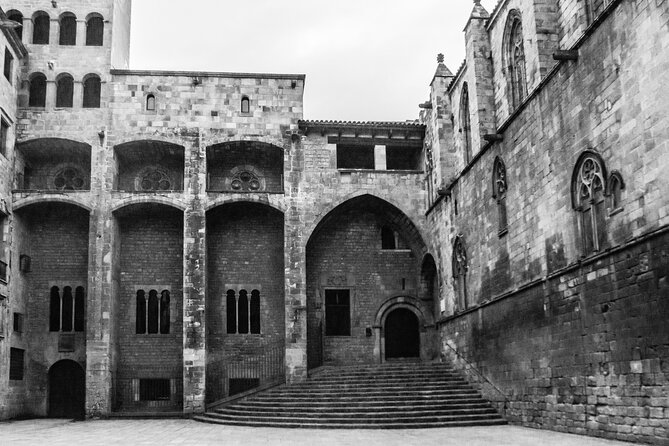
Plaça del Rei follows, a monumental square surrounded by Gothic and Renaissance buildings. The tour highlights that many buildings here are connected to the Royal Palace, tied to the residence and government of the Counts of Barcelona and the Kings of Aragon. In practice, this stop works because it helps you read the whole area like a political map: who ruled, where decisions happened, and how power shaped the center.
Other things to see around Barcelona
- Barcelona Tapas and Wine Experience Small-Group Walking Tour★ 5.0 · 5,804 reviews
- Barcelona: Tapas Walking Tour with Food, Wine, and History★ 4.8 · 4,261 reviews
- Barcelona: Food Walking Tour with Tapas and Wine★ 4.9 · 2,180 reviews
- Barcelona Tapas Walking Tour: Food, Wine & History★ 4.5 · 1,928 reviews
- Barcelona Helicopter, Sailboat & Old Town Private Walking Tour★ 5.0 · 1,395 reviews
- Barcelona: City Walking Tour with a Local Guide★ 4.9 · 1,384 reviews
MUHBA Ruins and the Columns of the Temple of Augustus
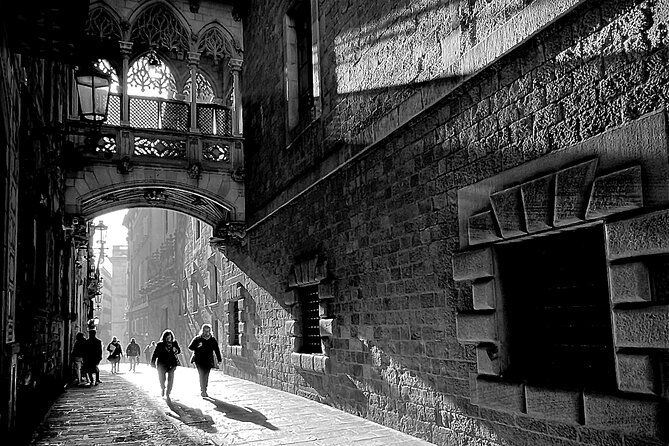
You then reach Museu d’Historia de Barcelona, MUHBA, where you can visit 4000 m2 of Roman ruins. Important planning note: admission tickets are not included here. That means you can still walk the area and take in the surroundings, but for the museum itself you will need to handle tickets separately.
If you are the type who likes to connect the dots visually, MUHBA is a strong choice to keep the story consistent. You already saw Roman remnants from street level, so stepping into a museum space lets you treat what you saw outside like the opening chapter, not the whole book.
Next is Centre Excursionista de Catalunya, where you see four Roman-period columns from the Temple of Augustus. This is one of those Barcelona details that feels like an insider trick, because it turns a modern street facade into a clue about what is under your feet. It is also a great “wait, really?” moment that makes the walk memorable.
Pont del Bisbe, City Hall, and Generalitat: Power in Stone
Pont del Bisbe is one of Barcelona’s most photographed bridges. The tour treats it like more than a photo stop, sharing secrets and legends tied to the spot. You get about 5 minutes, which is short, but enough time to look from the angles that make it feel dramatic and to catch the story thread the guide is using.
Then you come to City Hall, Casa de la Ciutat or Ayuntamiento. After that, you see Palau De La Generalitat de Catalunya, the government of Catalonia. Together, these stops make a clear point: the Gothic Quarter is not only churches and medieval streets. It is also governance and civic identity, built in stone where officials actually operated.
This is also where the guide’s approach matters. One guide on this tour, Alfredo, is praised for explaining historical landmarks with both the good and the bad and the ugly. That style helps you keep seeing the city as lived-in and complicated, not just pretty.
Castellers and Gaudí Lamps: From Tradition to Design
Monument als Castellers is next, honoring the Human Towers tradition in Catalonia. This is one of the best “culture in action” breaks on the route. Even if you are only viewing a monument, you are reminded that some traditions live in performance, not museums.
After that, you reach Plaça Reial, a square that connects the Gothic area with Las Ramblas. The tour points out one of Antoni Gaudí’s very first works, the special street lamps. This is a fun shift from medieval structures to a design signature that shaped how Barcelona feels visually even beyond the famous modernist landmarks.
Then you pass through Plaça George Orwell. It is a short stop, but it keeps the walk grounded in the modern identity of the area. Barcelona’s old quarters are not frozen. Names and meanings keep changing with time.
Plaça dels Traginers comes next, where you can enjoy an old Roman tower. It is brief, but it reinforces a theme you have already been building all walk long, that Roman traces keep showing up in unexpected corners.
Santa Maria del Mar and Mercat del Born, the Born’s Best Story Turns
Basílica de Santa Maria del Mar is one of the major stops in El Born. The tour notes that depending on time, you may be able to go inside. That flexible detail matters because it shapes how you should plan your expectations. If you cannot go in, you still get the outside presence and the historical frame.
Then you stroll along Passeig del Born, described as a nice boulevard in the Born area. This segment is a helpful pause. After many architectural and historical points in a tight area, this is where you can breathe and reset before the market and ruins.
Mercat del Born is next. The tour treats it as an old market that now functions as a cultural center because of the ruins of the 18th century you can see underground. It is a powerful idea: you are not only looking at a building that survived. You are looking at layers that were preserved in place.
You end with Patisserie Hofmann. The tour gives you time here to grab a dessert or even a drink at a nearby place. The practical win is that this ending is close to public areas and lively streets, so you are not stuck searching for your next meal right after the tour.
Price and Value for a Private 3-Hour Tour
At $180.04 per person for a private 3-hour walking tour, this is not a bargain-basement deal. But it can still feel reasonable because you are paying for a focused route through the Gothic Quarter and Born, in English, with a single group experience rather than crowd management.
You also get a lot of included stops that are free to view, with only a couple of clear ticket exceptions. Santa Maria del Pi and MUHBA have admission not included, while most other stops list admission as free. That reduces the chance you get hit with surprise entry costs during your walk.
The tour also includes a mobile ticket, plus confirmation at booking time. If you like the idea of having an organized path that still lets you branch out afterward, the format fits.
Group discounts are mentioned, which can be helpful if you are booking with more than one couple or a small friend group. Because it is private, you avoid the common issue of getting separated from your people while still benefiting from a guide’s structure.
Who This Tour Best Suits
This tour is a strong fit for you if:
- You want a first-time orientation to the Gothic Quarter and Born in a short window
- You like your sightseeing connected with context, including Jewish quarter history and the 1938 bombing traces
- You prefer a private, English-guided walk rather than a large-group rush
- You want a built-in food moment with Boqueria and a sweet finish at Hofmann
It might be less ideal if:
- You want long interior time at every site. Many stops are brief by design, and two key interiors require tickets not included.
- You do not enjoy walking segments. It is a walking tour, with lots of stop-and-look moments.
Should You Book This Private Barcelona Old Town Walking Tour?
Yes, if your goal is to get oriented and understand what you are seeing, this route makes a lot of sense. The combination of Roman traces, Gothic landmarks, Jewish quarter context, and Born market ruins gives you a layered picture of Barcelona without needing a full day.
Before you book, do one simple prep move: decide if you want to pay extra for Santa Maria del Pi and whether MUHBA interests you enough to spend time inside. If you are excited about Roman ruins and historic comparisons, you will likely appreciate those stops even more.
If you want a guided walk that ends where the atmosphere is good and the dessert is easy, this one is a practical choice.
FAQ
How long is the Private Barcelona Old Town Walking Tour?
It is listed as approximately 3 hours.
Where is the meeting point and when does the tour start?
The meeting point is Apple Passeig de Gràcia, Pg. de Gràcia, 1, Eixample, Barcelona, and the start time is 4:00 pm.
Where does the tour end?
The tour ends at Mercat del Born, Plaça Comercial, 12, Ciutat Vella, Barcelona.
Is this tour private?
Yes. It is a private tour/activity, and only your group participates.
What language is the tour offered in?
It is offered in English.
Is there a mobile ticket?
Yes, the tour includes a mobile ticket.
Are service animals allowed?
Yes, service animals are allowed.
Which stops have admission tickets that are not included?
The tour notes admission tickets not included for Basílica de Santa Maria del Pi and for Museu d’Historia de Barcelona, MUHBA.
What is the cancellation policy?
Free cancellation is available. You can cancel up to 24 hours in advance for a full refund. If you cancel less than 24 hours before the start time, the amount paid is not refunded.
The latest to open for booking



Gothic Quarter Walks, side by side.
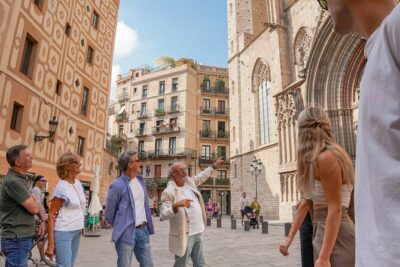
Barcelona all included: Sagrada, Park Güell, Montjuic & Gothic
Read our review →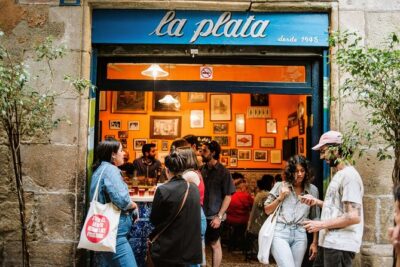
Barcelona Gothic Quarter Tapas & Taverns Food & Wine Tour
Read our review →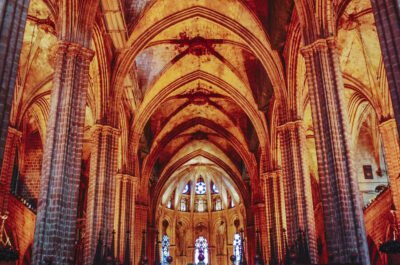
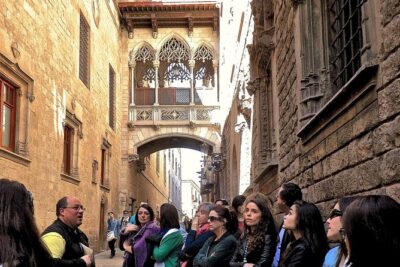
Barcelona Old Town & Gothic Quarter Small Group Tour
Read our review →
Ramblas, Old Town, Gothic and Gaudi Architecture Walking Tour
Read our review →
El Born and Gothic Quarter Wine & Tapas Bar Tour
Read our review →
El Born Food Walking Tour with Tapas and Drinks
Read our review →
Kids and Family Gothic Quarter Walking Tour in Barcelona
Read our review →Where else this one turns up